-150x150.jpg)
Key Takeaways:
- Words—including pronouns—have meaning and carry a message with them. Likewise, preferred pronouns carry a message about gender ideology that not everyone wants to speak.
- Viewing pronouns as personal preferences reframes human identity as subjective individual expression rather than grounded in objective biological reality.
- Compelling preferred pronoun usage violates the freedom of speech in the First Amendment.
In J.R.R. Tolkien’s classic The Fellowship of the Ring, Boromir says concerning the one ring, “Is it not a strange fate that we should suffer so much fear and doubt for so small a thing? So small a thing!” In some ways, this encapsulates what some feel about the debate over so-called “preferred pronouns.” Are pronouns really such a big deal?
The answer is yes!
Pronouns are small words with big implications. When signifying persons, pronouns often carry other characteristics of the people they refer to, like number and gender. And until recently, most people understood gender to be binary (male or female). But now, an ever-growing list of pronouns have become expressions of one’s self-proclaimed identity, a claim that proponents insist everyone must affirm—or else.
Some people have lost their jobs or been threatened with termination because they decline to use certain pronouns due to the message about human nature that those terms inherently and unavoidably communicate. In other cases, people have been banned from common or public spaces—all because they believe what has been obvious to human society for thousands of years: that a man is a man, and a woman is a woman.
Let’s look at how pronouns have become a battleground for the radical gender ideology inundating our culture.
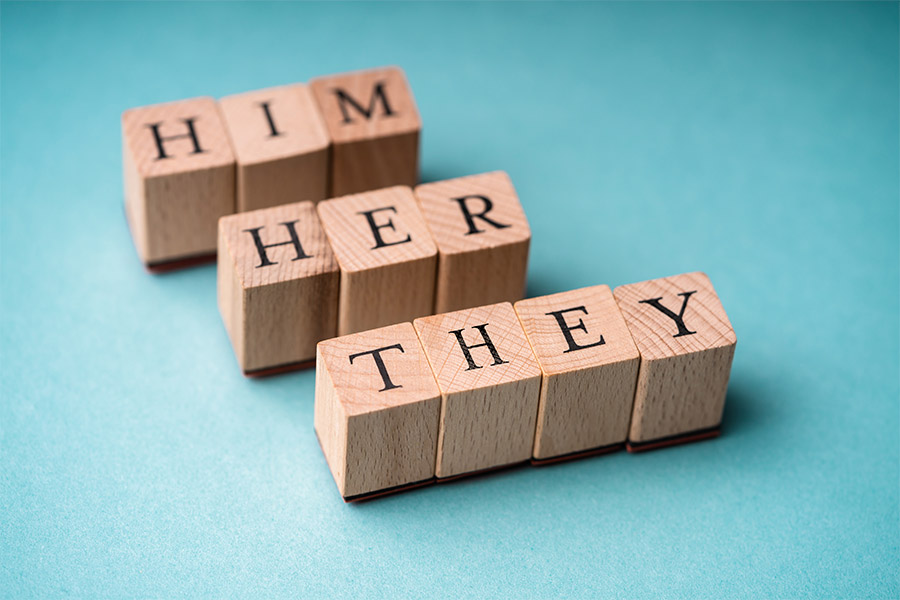
What is a pronoun?
To review a little grammar, Merriam-Webster defines a pronoun as “a word that is used instead of a noun or noun phrase. Pronouns refer to either a noun that has already been mentioned or to a noun that does not need to be named specifically.”
For example, instead of using someone’s name repeatedly (e.g., “Dave did this. Then, Dave did that.”), we could just say, “Dave did this. Then, he did that.” Or, a noun phrase like “the kids in orange shirts” could be replaced with “they” if you wanted to refer to the same kids multiple times. These are simple examples, but they show how often we use pronouns in English.
Pronouns and gender
In English, third-person singular pronouns can carry the implied gender of the noun they refer to. In the example above, Dave, a man, was referred to with the pronoun “he.” A woman would be referred to with a “she” pronoun. A rock would be called “it,” which doesn’t have an implied gender. First-person pronouns (I/we), second-person pronouns (you), and third-person plural pronouns (they) do not carry an implied gender.
For an individual whose gender is not known or isn’t necessary to determine, there is now debate over which third-person singular pronoun to use. Historically, we have used the pronoun “he” in a generic sense. In the past several decades, some have suggested replacing the generic “he” with “he or she,” “s/he,” or “she.” A generic statement might also use the pronoun “one” (e.g., “In such situations, one might like to do this.”). And the third-person plural pronoun “they” has become increasingly used to refer to a singular individual whose gender is not known or specified (though it is important to add that this usage was historically not meant to imply that a person was not a male or female).
However, in any of these cases, whenever a particular person is in mind (Dave, Taylor, Molly, Bernice, Joey, etc.), the pronouns “he” or “she” have traditionally been used to refer back to that individual, reflecting the sex of the person being discussed.
Why are pronouns being debated?
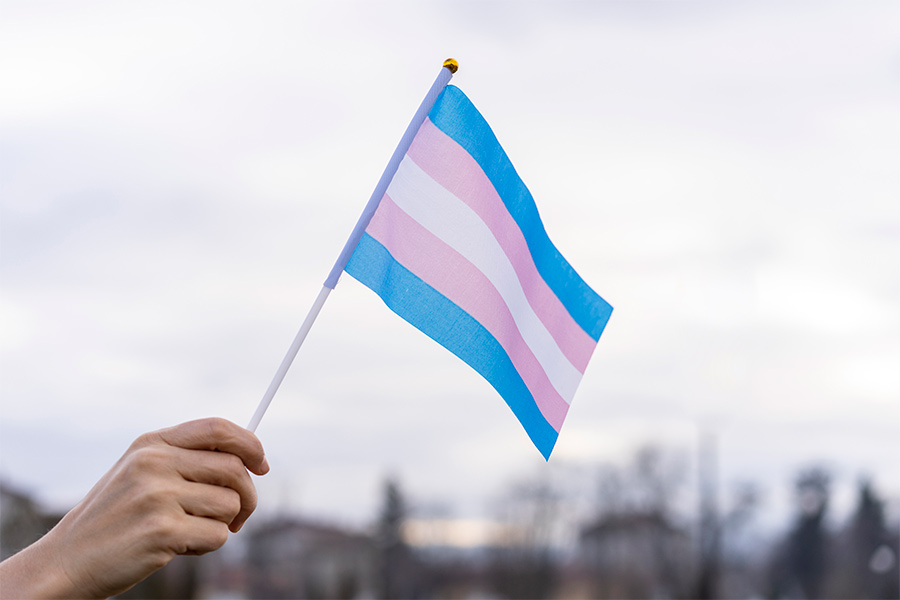
Now, two major cultural trends have converged to question the foundational principles about gender and pronouns.
The first trend is that basic facts about sex, gender, and the gender binary are being denied. According to activists, no longer is gender determined by body and biology but by “gender identity,” which the World Health Organization defines as “a person’s deeply felt, internal and individual experience of gender, which may or may not correspond to the person’s physiology or designated sex at birth.” If an “internal and individual experience” is accepted as the source of one’s gender, then “gender” can come to mean whatever the individual claims, even without making reference to male or female categories.
The second trend, as theologian and historian Carl Trueman has noted, is that a new “modern self” has emerged. This modern self is defined by expressive individualism, where “authenticity is achieved by acting outwardly in accordance with one’s inward feelings.” It also demands that “society at large will recognize and affirm this behavior,” such that “any attempt to express disapproval is therefore a blow not simply against particular ways of behaving but against the right of that person to be whoever they wish to be.”
As you might imagine, such logic can move (and usually intends to move) well beyond the gender binary. For many in our modern culture, “gender” is no longer correlated to an empirical reality like the body but has become a mere expression of one’s own self-perception or self-declaration. It has become, like so many other things, a mode of expressive individualism.
This shift in thinking has changed how our culture demands that pronouns be used and has even sparked the invention of new “pronouns.” Instead of referring to the biological sex of an individual, pronouns are now demanded to reflect a person’s asserted gender identity. And with the growing number of asserted gender identities, the number of pronouns has grown at an even faster rate, as each gender identity can create its own set of pronouns.
What are “preferred pronouns”?
So-called “preferred pronouns” are the pronouns by which someone wants (or prefers) to be referred to by others. These pronouns could be ones that most people are familiar with like “he” or “she.” An individual who identifies as “non-binary” (claiming to be neither male nor female) may use “they” as his or her pronoun.
Some people will use a combination of different pronouns. They may even adopt multiple sets of pronouns that can change from moment to moment, over time, or depending on the setting. Some pronouns are even designed to communicate non-human identities.
Conceiving of pronouns as something to be specified by the individual (with a potentially infinite array of choices), rather than as words that are proper or improper to use depending on who or what is being referenced, is the first step in gender ideology activists’ attempt to redefine the relationship between sex and human identity. And that’s before you even get to which pronouns to use. All of this illustrates the message that viewing pronouns as “preferred” instead of proper is designed to communicate that every reality about human identity is rooted in one’s will rather than in nature.
What are neopronouns? What are noun-self pronouns?
A relatively recent but entirely predictable phenomenon in the world of pronouns is the invention of neopronouns. According to The New York Times, a neopronoun “can be a word created to serve as a pronoun without expressing gender.” Examples are ‘xe/xir/xirs,’ ‘ze/zir/zirs,’ ‘ey/em/eir,’ etc. (as opposed to ‘he/him/his’ or ‘she/her/hers’). With neopronouns, a person’s pronouns don’t need to reflect the gender binary. Gender becomes a creation of the individual and loses almost any connection to the physical world.
A subset of neopronouns is noun-self pronouns. The Times explains that noun-self pronouns are “a pre-existing word … drafted into use as a pronoun. Noun-self pronouns can refer to animals — so your pronouns can be ‘bun/bunself’ and ‘kitten/kittenself.’ Others refer to fantasy characters — ‘vamp/vampself,’ ‘prin/cess/princesself,’ ‘fae/faer/faeself’ — or even just common slang, like ‘Innit/Innits/Innitself.’” In other words, a noun-self pronoun doesn’t even need to reflect the fact that you are a human being.
While most people would consider neopronouns and noun-self pronouns outlandish, they reflect the culture’s expressive individualism that tries to root one’s identity in purely internal and psychological phenomena. If our understanding of sex and gender is severed from our embodied reality, there’s no stopping a person from identifying as the opposite sex, no sex, both sexes, or nonhuman things like animals, objects, fictional characters, or abstract concepts. Without the human body as the source of one’s identity, “I am a woman trapped in a man’s body” becomes just as plausible as “I am a wolf trapped in a human body.” One’s identity is limited only by one’s imagination and feelings.
Pronouns and free speech
Words—including pronouns—have meaning. They carry a message with them. And this isn’t just the opinion of those who insist that pronouns reflect biological reality:
- A communications officer for GLAAD says that using a person’s “preferred pronouns” is a “really simple way to affirm their identity.”
- The Human Rights Campaign says that “using a person’s chosen name and pronouns is essential to affirming their identity and showing basic respect.”
- A resource page at the University of Wisconsin – Milwaukee says that using a person’s asserted pronouns is a way “to show your respect for their gender identity.”
- The National Education Association notes that using preferred pronouns is important because they “affirm gender identities.”
Thus, even LGBT activists agree that pronouns are important because they carry a message when they are used.
Some might read all this and wonder, “So what? How is this going to affect me? I will simply use accurate pronouns.”
Unfortunately, radical gender ideology and its accompanying pronoun demands aren’t giving people that freedom. Many corporations and government officials label it offensive, discriminatory, and harmful not to use a person’s “preferred pronouns.” And, in the name of diversity and inclusion, this leads them to fire or “cancel” those who don’t toe the line. Ultimately, activists’ goals are to change the way you think, to punish any dissent, and to render it difficult (if not impossible) to communicate the truth that God created each of us either male or female.
Several Alliance Defending Freedom clients have already been punished because they declined to use pronouns about a person that are untrue, don’t reflect reality, and would reinforce ideas that are harmful to that individual. The fact is, if you believe that being a man matters, that being a woman matters, even that being human matters, you might be next.
Educators and pronouns
Teachers and professors have been frequent targets of government pronoun policies. Many public school districts and universities have adopted policies requiring staff to use students’ “preferred pronouns” or face punishment. Some policies even require teachers to lie to parents by actively hiding whether their child is using a different set of pronouns at school than they are at home. These policies violate the rights of teachers and parents.
- Dr. Nicholas Meriwether has served as a philosophy professor at Shawnee State University in Ohio for over 20 years. One day, a male student demanded that the professor refer to him by feminine titles and pronouns. But doing so would endorse an ideology that conflicted with Dr. Meriwether’s beliefs, so he tried to reach a compromise by using the student’s preferred first or last name. But this wasn’t enough. Eventually, the university formally charged Dr. Meriwether and threatened “further corrective actions” if he did not use the student’s chosen pronouns. ADF filed suit on Dr. Meriwether’s behalf, and in 2021, the U.S. Court of Appeals for the 6th Circuit ruled in his favor, holding that the university had violated the professor’s right to free speech.
- Peter Vlaming worked as a French teacher for almost seven years at West Point High School in Virginia. In 2018, one of Peter’s female students began to identify as male. Peter went out of his way to accommodate this student. He agreed to use the student’s preferred name and to avoid using pronouns to refer to the student. This wasn’t good enough for the school district, and the district punished and fired Peter—not for what he said, but for what he could not say. That’s why ADF filed a lawsuit to protect Peter’s constitutional right not to speak messages against his core beliefs. And thankfully, in December 2023, the Virginia Supreme Court reinstated Peter’s case and affirmed that Virginians have a right not to be forced to express messages that violate their beliefs. This monumental ruling led the school board to settle Peter’s case, including $575,000 in damages and attorneys’ fees.
Parental rights and pronouns

In addition to teachers, parents who express concerns about these policies are being vilified and denied their right to direct the upbringing, education, and healthcare of their children.
- In Michigan, ADF filed suit against a school district on behalf of Dan and Jennifer Mead after district employees began treating the couple’s middle-school daughter as a boy without their knowledge or consent and then taking steps to conceal these actions from the parents. Employees had even altered some of the girl’s official records to remove references to the district’s new name and inaccurate pronouns for her before sending them home. The Meads only discovered the district’s actions when an employee unintentionally failed to completely alter a report about their daughter before sharing it with them.
- ADF attorneys filed suit against a New York school district after officials there began treating a middle-school girl as a boy without her mother’s knowledge or consent. Jennifer Vitsaxaki withdrew her daughter from Skaneateles Central School District soon after she learned that school employees had begun to treat her daughter as a boy. Without notifying Jennifer or seeking her consent, employees began to refer to her daughter with a masculine name and third-person plural pronouns inconsistent with her daughter’s sex. When Jennifer confronted school officials, they defended their actions, citing district policy.
Pronouns in adoption and foster care
The effects of coercive pronoun policies are extending beyond education into other fields like foster care and adoption.
- In Washington, ADF is representing Shane and Jennifer DeGross, who had taken in vulnerable children for nine years as foster parents. But when the DeGrosses sought to renew their license in 2022, they learned that Washington had enacted new regulations requiring all foster parents to express the state’s views on human sexuality, including being required to use “preferred pronouns.” When the DeGrosses said that they would love and support any child placed in their home but could not lie to a child about who they are, Washington officials restricted their ability to welcome loving homes.
- Two families in Vermont, the Wuotis and the Gantts, had their foster-care licenses revoked for similar reasons. Despite the families’ track records of success and high praise from social workers who knew them, Vermont’s Department for Children and Families revoked their foster-care licenses after the couples expressed their belief—informed by their Christian faith and biological fact—that girls cannot become boys or vice versa. They also expressed concern about the department’s policy requiring them to use “preferred pronouns,” take children to pride parades, and push children to reject their bodies. Thankfully, in February 2026, Vermont officials finalized a new policy clarifying that foster families don’t need to abandon their religious beliefs or promote gender ideology to qualify as foster parents.
Pronouns and businesses
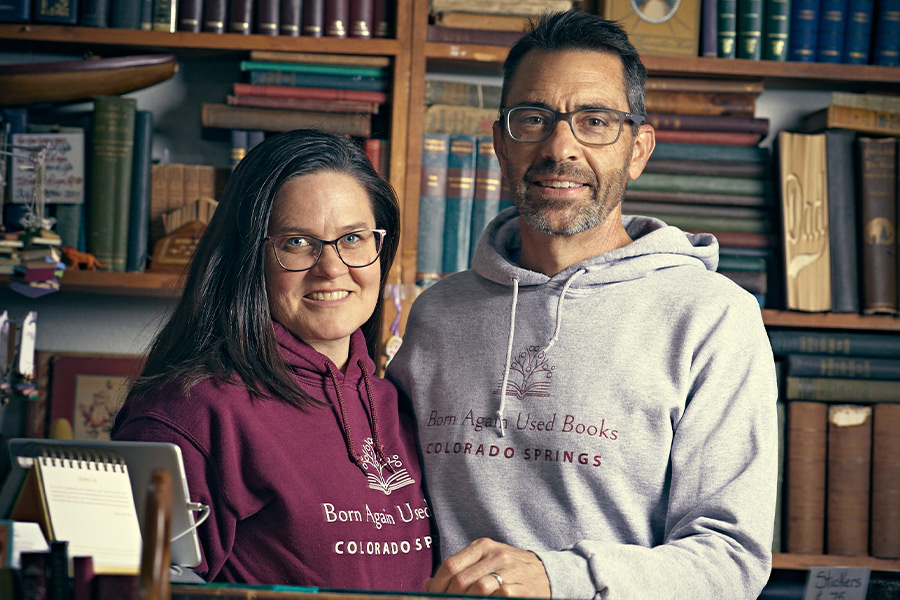
Businesses aren’t exempt from the pronoun police either. Under the guise of “public-accommodation laws,” states like Colorado are forcing businesses to use a person’s “preferred pronouns,” even if they are inconsistent with the person’s sex.
- Born Again Used Books is a Christian bookstore in Colorado Springs. The store is owned by Eric Smith, and he co-manages it with his wife, Sara. Eric and Sara are strong Christians who routinely incorporate their faith-based values into the way they operate their business, including how they and their employees interact with customers. While the Smiths adhere to their deeply held beliefs in the way they run their business, they serve all customers with respect, no matter who they are. But they can’t speak messages that go against their beliefs. This principle puts Born Again Used Books in conflict with Colorado law, which would force them to people individuals using inaccurate pronouns.
- XX-XY Athletics is a Denver-based athletics apparel company owned by Jennifer Sey. By founding XX-XY Athletics, Jennifer Sey wanted to create an apparel company known for advocating for female athletes and the reality of biological sex. Even the company’s name refers to male and female chromosomes and the fact that sex cannot be changed. In its advertisements, on its social media platforms, and on its website, XX-XY Athletics regularly refers to male athletes using male pronouns and the names they were given at birth, even if they identify as female. For XX-XY Athletics, to do otherwise would be to perpetuate the lie that men can become women. But the same Colorado law mentioned above also threatens the free speech of XX-XY athletics.
The wide reach of pronouns and free speech
Because pronouns are a part of everyday speech, it should come as no surprise that government-mandated pronoun policies reach even further—from Christian schools to faith-based healthcare providers.
Thankfully, ADF continues to win many of these cases. No one should have to violate their conscience by being forced to speak a message about human nature contrary to their beliefs.
Conclusion
It is indeed a strange fate that small words like pronouns have become one of the biggest battlegrounds of identity politics today.
We can be sure that the logic of expressive individualism will not stop with attempts to enforce the use of opposite-sex pronouns, non-binary pronouns, and neopronouns. It will continue into noun-self pronouns or whatever may come after that.
Our human nature, and the pronouns we use to reflect it, need to be grounded in the empirical reality of one’s sex and the body. Only then can the disastrous “logic” of expressive individualism and preferred pronouns be brought to a halt.
-1024x1024.jpg)
Related Articles