

Key Takeaways
- For decades, Vermont barred religious schools from its tuition program for students in towns without public schools.
- After courts struck down that exclusion, Vermont passed Act 73. Its new rules disqualify all 15 previously eligible religious schools, while 45 secular private schools still qualify.
- Carrie and Greg Bishop are paying out of pocket for their daughter’s senior year at a religious school, and Carrie took a second job to help cover tuition.
- ADF is asking a federal court to restore the Bishops’ tuition funding, re-open Dual Enrollment to their daughter, and declare Act 73’s religious exclusion unconstitutional.
For decades, Vermont excluded religious schools from a public tuition program that families at secular schools could use. Federal courts have rejected that exclusion, and the U.S. Supreme Court has held that a state can’t cut schools out of a public benefit just because they are religious.
But instead of treating religious schools and families fairly, Vermont’s response was to rewrite its laws to cut out religious schools on other grounds, like class size, location, and whether a certain percentage of their students were publicly funded during one year. In other words, the state of Vermont is engaging in a pattern of behavior that could be described as religious gerrymandering. Instead of discriminating explicitly on the basis of whether a school is religious, which the Supreme Court forbade, it is trying to accomplish the same goal through other means.
The result is that families like the Bishops are left to pay on their own. Their daughter, A.B., is a senior at a religious school. Carrie has taken on a second job to help cover tuition. Had the Bishops chosen a secular school, the state would be paying the bill.
Now Alliance Defending Freedom has filed a federal lawsuit on the Bishops’ behalf, asking a court to end Vermont’s religious discrimination.
How the Bishops chose Mount St. Joseph
In Vermont, some school districts don’t operate their own public high schools, especially in rural areas. Under the Town Tuition Program, those districts pay for their students to attend the public or approved private school their parents choose. Dual Enrollment, a related program, lets 11th and 12th graders take up to two college courses at no cost to their families. Private school students qualify for Dual Enrollment only if their tuition is publicly funded. These programs were created to give parents flexibility and choice. For the Bishops, that choice starts with faith.
Carrie and Greg Bishop are Christians who believe God has given parents the primary responsibility to raise and educate their children in the faith. They teach that faith at home, take their children to church, and send them to Christian youth groups and camps. They also look for schools that share their beliefs.
That wasn’t always possible. When the Bishops’ two sons reached high school, Vermont excluded religious schools from tuition funding, and the family couldn’t afford private tuition on its own. The sons attended public school, where they faced backlash for bringing their Bibles. Carrie and Greg also saw that much of what public schools taught conflicted with what they taught at home.
So with their three daughters, the Bishops homeschooled through 8th grade, then chose Mount St. Joseph Academy, a private Catholic school. The Bishops aren’t Catholic, but they share the school’s core Christian beliefs, and its education reinforces what they teach at home.
A.B., the youngest, is a senior at Mount St. Joseph and shares her family’s faith. In August, she also began dealing with health struggles. That would be a lot for any family to grapple with—let alone a family that’s being discriminated against by state policy.
A law that no religious school can satisfy
Vermont was forced to open its tuition program to religious schools in the 2022–2023 school year, only after the U.S. Court of Appeals for the 2nd Circuit’s rulings and the Supreme Court’s decision in Carson v. Makin. Less than three years later, it slammed the door again.
Act 73, signed July 1, 2025, doesn’t use the “R” word—“religion.” Instead, it sets three new requirements for private schools to participate in the town tuition program:
- First, a school must be located where at least one district doesn’t run its own public school. That shuts out schools in more populated areas like Rutland and Burlington.
- Second, at least 25 percent of a school’s students must have been publicly funded in the 2023–2024 school year. Religious schools had been barred until fall 2022, so they only had one year to reach that mark.
- Third, a school must meet minimum average class sizes, including 18 students in grades 9 through 12, unless the state grants a waiver. That penalizes smaller religious schools.
None of the 15 religious schools that were eligible in 2024–2025 qualify now. Forty-five secular private schools still do.
The legislative record points in the same direction. Vermont’s tuition program has long let families choose schools across the state line, and an early draft of Act 73 would have let districts pay for private schools in bordering states without the 25 percent requirement. Sen. Kesha Ram Hinsdale said it was important to apply the requirement to those schools too, because otherwise “we’re starting to send people back to religious schools over the border and someone could have a religious school right over the border.” Her concern was clear: Without the 25 percent rule, religious schools could qualify.
Furthermore, a grandfather clause should have protected the Bishops’ daughter. Act 73 lets students who were already attending a now-ineligible school stay until they graduate, and A.B. was enrolled at Mount St. Joseph when the law passed. But in fall 2025, she spent one semester in a career-focused program at a local technical center and took a few classes at the adjoining public school before returning to Mount St. Joseph in January. This led the Barstow Unified Union School District to deny her tuition request, saying she lost her grandfather status by temporarily leaving Mount St. Joseph.
The school board admitted that A.B. met the grandfather clause’s plain text, which guarantees continued funding “until such time as a student graduates from that school.” But the board arbitrarily decided those words really mean until a student leaves—a condition the law never mentions.
The Bishops take Vermont to federal court
In October 2026, ADF attorneys filed a lawsuit on behalf of Carrie, Greg, and A.B.
Simply put, Act 73 violates the First Amendment by forcing the Bishops to choose between their faith and a public benefit. It violates the Fourteenth Amendment by penalizing parents for exercising their right to direct their daughter’s education. And it denies equal protection by treating religious families worse than other families in a similar position.
The Bishops are asking for Barstow Unified to pay A.B.’s tuition at Mount St. Joseph for the entire 2026–2027 school year and to open Dual Enrollment to her this spring so she can take a college English course. Just as importantly, they are asking the court to declare these exclusionary policies unconstitutional.
Equal treatment is at stake
For A.B., the stakes are immediate. She has one senior year, and her family is covering tuition while she deals with her ongoing health struggles. Dual Enrollment would also let her take online college classes, which would make it easier to keep up with her appointments. Meanwhile, her mother’s second job means less time at home with her.
But this isn’t only about one family. Act 73’s rules shut out religious schools across Vermont and the families who choose them.
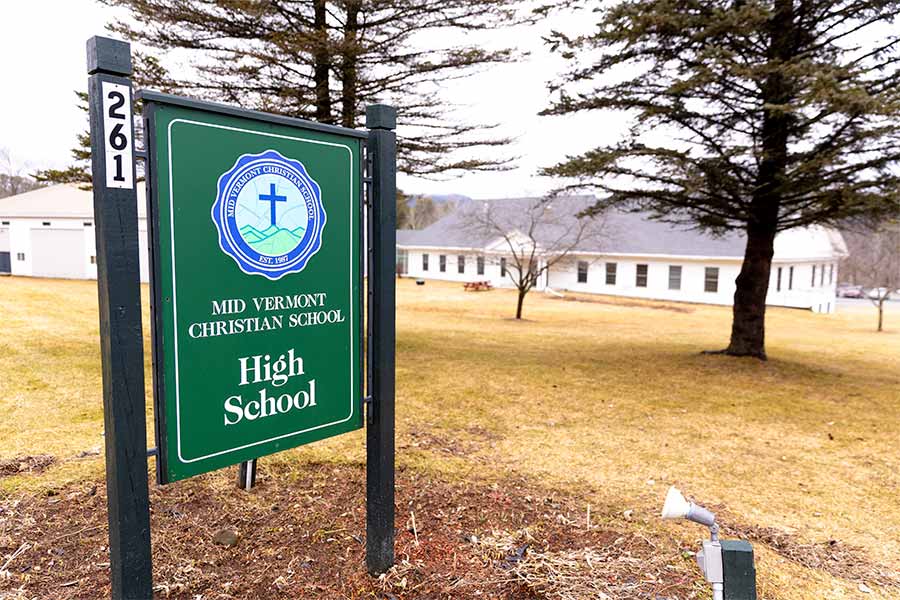
Mid Vermont Christian School and one of its families are similarly asking the 2nd Circuit to end Vermont’s religious discrimination. On Sept. 22, ADF Senior Counsel David Cortman argued that Vermont’s exclusion of religious schools violates the First Amendment now just as it did before. The district court had denied a preliminary injunction on the tuition claim in May, and ADF appealed.
Vermont isn’t required to fund private schools. But once it does, the Constitution requires equal treatment. Religious schools and the families they serve aren’t second-class citizens, and the state shouldn’t treat them that way.
The bottom line
Equal treatment isn’t optional. After the 2nd Circuit and the U.S. Supreme Court rejected religious exclusions from tuition programs, Vermont found another way to get the same result: 15 religious schools out, 45 secular private schools still in. That sort of discrimination is unconstitutional, and it’s families and students who are suffering the consequences.
Bishop v. Saunders
- September 2022: Following Carson v. Makin, Vermont’s Secretary of Education told school districts they may not deny tuition payments to religious schools, and religious schools began participating in Town Tuition.
- July 2025: Gov. Phil Scott signed Act 73, which set location, a publicly funded threshold requirement, and class-size requirements for private schools, disqualifying the 15 religious schools that were previously eligible.
- October 2026: ADF attorneys filed Bishop v. Saunders in federal court, asking the court to restore A.B.’s tuition funding and allow her to participate in Dual Enrollment.
Related Articles