
Key Takeaways:
- Satire has long been used to critique those in power through exaggeration or untruths.
- New Mexico passed a law (HB 182) censoring political speech that uses artificial intelligence (AI).
- The First Amendment doesn’t allow the government to censor speech—whether it’s spoken, written, or generated using AI.
- The Babylon Bee is challenging HB 182 in court to protect free speech and satire.
Political satire has a long and cherished history in the United States. Publications like The Onion have, for decades, made their readers think and laugh by intentionally publishing misleading headlines, fake news, and over-the-top stories.
Sometimes, satire is there just to get a laugh; sometimes, it mocks; and at other times, by wrapping a falsehood around a grain of truth, it delivers something deeper—and just as necessary—a critique of those in power. In these ways, satire and parody can make audiences do a double-take by convincing them that they are seeing something serious and then allowing them to laugh at their own gullibility when they realize that they are really viewing satire or parody.
This is one reason the Supreme Court has protected parody and satire, along with many other forms of political speech. The ability to express one’s ideas and critique those in power, even by stating something exaggerated, is a crucial element of what it means to live in a free society.
In other words, political satire—even satire that relies on literal falsehood—isn’t a bug of democracy. It’s a feature.
However, several states have been trying to crack down on satire and parody under the guise of rooting out “disinformation.” Specifically, these laws target content created by artificial intelligence (AI). They have passed laws banning AI-generated content on state political issues unless it’s posted with a government-scripted disclaimer telling people that the parody or satire is, in fact, not true.
This not only kills the joke—it also kills freedom of speech.
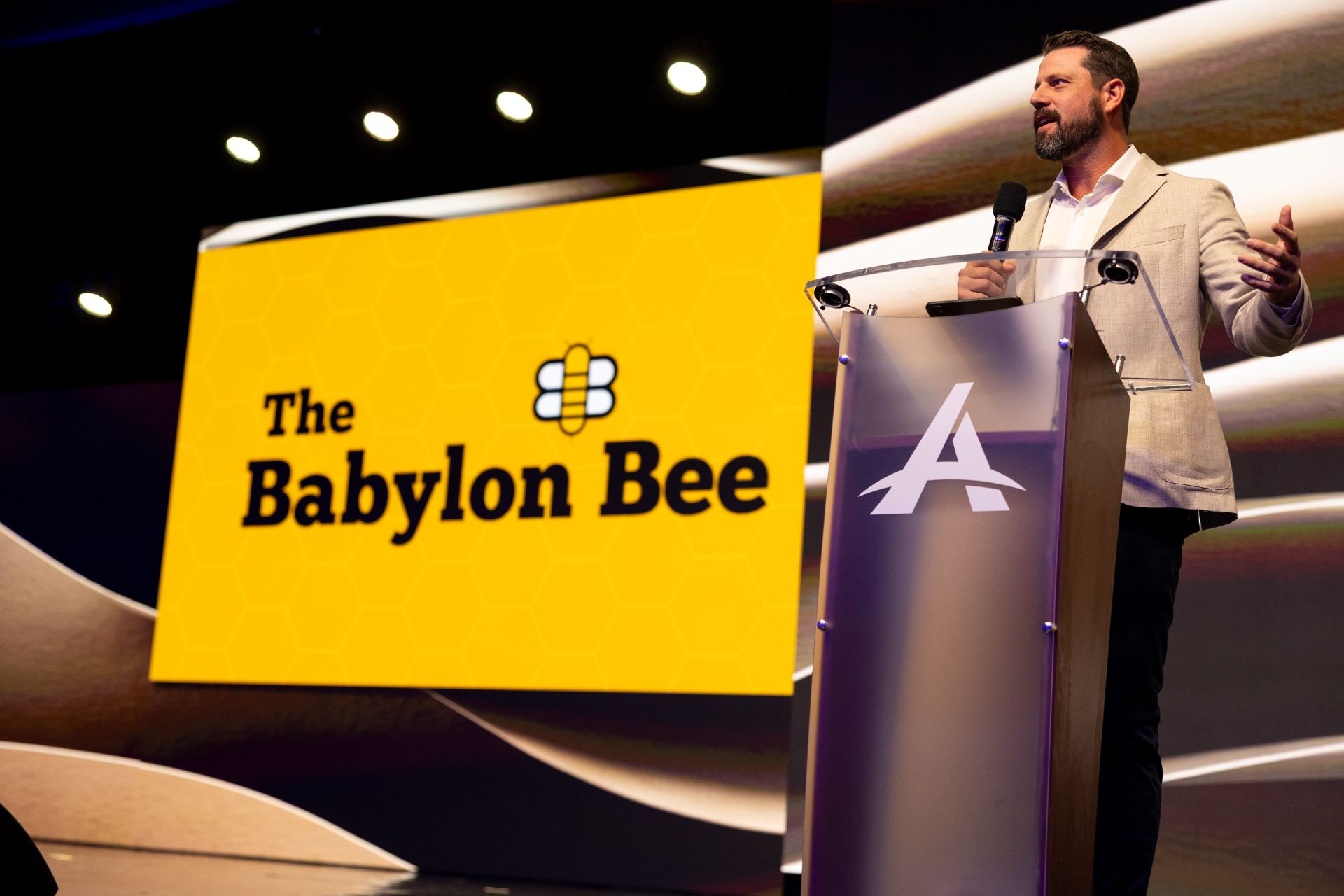
By compelling content creators to speak government-approved talking points or silencing themselves, it allows the government to shield itself from criticism and ridicule. That is why satire website The Babylon Bee is challenging a law in the state of New Mexico (HB 182) that does this very thing.
Free speech must be defended. Targeting AI and satire is often a pretext to censor other forms of protected political expression. The government cannot decide what political speech is allowed.
What does New Mexico’s law do?
HB 182 was passed by the New Mexico legislature in February 2024 and signed by the governor the following month. HB 182 makes it a civil offense each time a non-exempted person “produces or purchases an advertisement that contains materially deceptive media” that does not include a state-scripted disclaimer.
The bill defines “materially deceptive media” as “an image, video or audio that: (1) depicts an individual engaged in conduct or speech in which the depicted individual did not engage; (2) was published, disseminated, distributed or displayed to the public without the consent of the depicted individual; and (3) was produced in whole or in part by using artificial intelligence.”
HB 182 requires the state-approved disclaimer to “appear in a clear and conspicuous manner in every language used in the advertisement.” For videos, the disclaimer has to appear throughout the “duration of the video in a size that is easily readable,” while audio must have the disclaimer read at the beginning, end, and at least every 2 minutes in between.
Even for satire and parody, the words that come first have to be: “This [media] has been manipulated or generated by artificial intelligence.”
Those who violate the law could be subject to lawsuits, restraining orders, and $1,000 fines for each violation.
Ironically, before and after passage, officials raised serious constitutional concerns about HB 182. Governor Michelle Grisham questioned its legality, and the attorney general concluded key provisions are likely unconstitutional. When even the government doubts its own law, you know it has real problems.
The Babylon Bee defends free speech in satire
New Mexico’s law directly impacts satire websites like The Babylon Bee. The Bee’s tagline is “Fake News You Can Trust,” and has been using satire and parody—including AI-generated images—to speak the truth, expose bad ideas, and encourage societal and political change.
The Babylon Bee has even generated content specific to New Mexico. For example, after Gov. Grisham declared gun violence a “public health emergency” in September 2023, which also included a 30-day ban on open and concealed carry of firearms, the Bee issued an article titled: “New Mexico Criminals Excited To Hear No One Will Be Armed For Entire Month.” After the governor’s actions were widely criticized, the Bee created a follow-up article: “New Mexico Governor Suspends First Amendment To Silence Criticism Over Suspending Second Amendment.”
The Bee has also created a satirical “travel advertisement” lampooning the state and its treatment of constitutional rights. The Bee plans keep making similar content in the future, including the use of AI-generated or AI-altered content, which is why they are standing up to protect free speech and satire.
This isn’t the Bee’s first rodeo challenging laws like New Mexico’s. The Babylon Bee and Alliance Defending Freedom have also teamed up to defeat similar attempts at censorship in California and Hawaii. Now, it’s time for New Mexico to learn a lesson about the importance of free speech.
The bottom line
This isn’t about AI—it’s about control. If you can be punished for a meme, you’re not living in a free society. But the government doesn’t get to decide what’s true in political debate. Americans do.
New Mexico’s law is censorship, plain and simple. The Constitution doesn’t allow the government to censor speech, whether it’s spoken, written, or generated using AI. Free speech isn’t a luxury—it’s a God-given right.
The Babylon Bee v. Castillo
- February 2024: The New Mexico legislature passes HB 182, censoring political speech that uses AI.
- May 2024: HB 182 goes into effect.
- August 2026: The Babylon Bee posts content restricted by HB 182. The Babylon Bee and ADF attorneys then file a lawsuit challenging HB 182.
Related Articles