
Key Takeaways:
- Despite the U.S. Supreme Court overturning Roe v. Wade in 2022, there are more abortions in America today than ever.
- To serve the unborn and their parents, we must advance legal arguments and inspire cultural change.
- This work is for all of us—not just those fighting in courtrooms and state legislatures.
Jean Marie Davis was trafficked from age 2 to 29 across 33 states. She suffered countless rapes and became addicted to drugs. Near the age of 30, she discovered that she was pregnant. After escaping death threats from a trafficker she worked for, Jean Marie eventually met a counselor at a pregnancy resource center named Phyllis, who shared a simple truth. She told Jean Marie, “I can’t heal all those things that you’re going through. But I know a man named Jesus who can help you.”
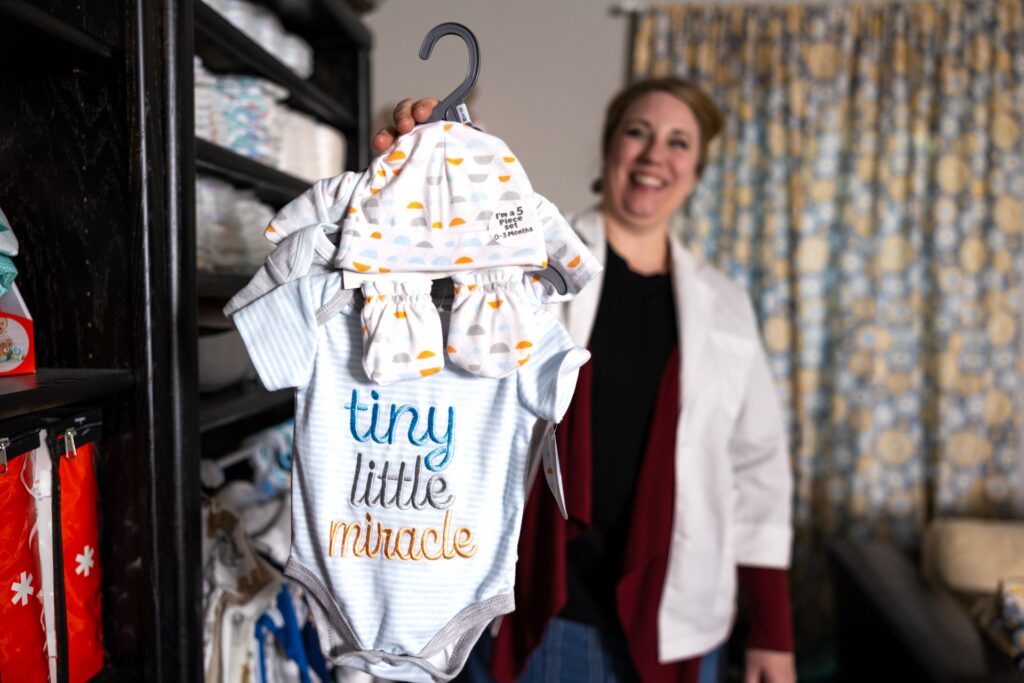
After that interaction, Jean Marie came to know Christ. Despite initially considering getting an abortion, she ultimately gave birth to a son named Jonah, who is now 11 years old. Today, Jean Marie helps women who share experiences similar to hers and is a passionate woman of faith. Her story shows what’s possible when someone chooses life—a choice that, for decades, existed within a legal landscape stacked against the unborn.
That landscape shifted in 2022, following decades of pro-life advocacy, the U.S. Supreme Court overturned Roe v. Wade. The Court’s decision in Dobbs v. Jackson Women’s Health Organization corrected the false notion that the Constitution includes a “right” to abortion and instead returned to the people and their elected representatives the freedom to make their own laws regulating abortion. While Dobbs was a victory worth celebrating, our work to protect the unborn is far from complete; today, there are more abortions than there were before the Dobbs decision. Without a broader cultural return to pro-life values, the smallest and most vulnerable of us remain in danger.
That leads us back to Jean Marie. She didn’t choose life because of a court’s decision. She chose life because of the grace of God made manifest in those around her. While the legal work is critical, it is stories like Jean Marie’s and Phyllis’s that will change the culture to value and cherish life for good.
There are more abortions in America today than ever before
Dobbs was a crucial win that is (and should be) celebrated. But tragically, there are more abortions in America today than before that decision, despite nearly 20 states passing laws protecting the unborn. The abortion industry estimates that abortions have increased by as high as 21 percent since 2022. Planned Parenthood’s own numbers indicate that it has performed more abortions in recent years than before Dobbs. That is despite temporarily losing federal funding and closing many of its facilities.
This increase is exacerbated by the now widespread use of mail-order abortion drugs. The Biden FDA dropped the long-required in-person office visit to dispense abortion drugs, which now account for the majority of abortions in America. This decision was meant to circumvent states’ pro-life laws and recklessly puts more children and women at risk.
Women like Rosalie Markezich, whose then-boyfriend ordered the drugs from a California doctor and then coerced her to take them, have felt the effects. After she tried unsuccessfully to vomit up the drugs, Rosalie’s baby passed away. Despite living in Louisiana, a state that prohibits abortion (with narrow exceptions), Rosalie and her child were left unprotected. She’s working to help ensure that no other woman is put in the same situation by challenging the FDA’s removal of the in-person dispensing requirement alongside her home state.
None of this is to discount the importance of the Dobbs decision and subsequent legal efforts to protect life. If every state were forced to permit abortions, these already startling numbers could be much higher. But the Dobbs decision is just a hollow promise so long as the FDA permits mail-order abortions. Cases like Rosalie’s are thus needed to protect the outcome of Dobbs by ensuring pro-life states can actually enforce their pro-life laws. But a legal victory in this case is just the beginning.
Bringing Christ’s love and joy to the world
Modern culture has incrementally been blinded to the inherent value, beauty, and joy of life. While the root cause is multifaceted, this trend is visible not only in increasing abortion rates but in other areas of society and bioethics. In the United States, Oregon was the first state to legalize assisted suicide in 1994. Today, over 30% of people live in jurisdictions that permit it. In the Nordic countries, children with Down syndrome are often selectively aborted—only 2-3 children with Down syndrome are born in Iceland every year. Nearly 60 million Americans reported binge drinking in the last month. Tens of millions have struggled with substance abuse. Depression rates are almost as high as they have ever been. Since 2007, there has been a 13-point increase in Americans who identify as religiously unaffiliated.
To best protect life, we have to share the truth behind why it has value in the first place. Law and policy can certainly go a long way in advancing cultural norms and values—studies have shown a correlation between an activity’s legality and its perceived morality. But legal change alone is not enough to protect the unborn. Pro-life views need to shift from being points in a legal and political debate to being part of the public’s understanding about what it means to be human. While state legislation enabled by the Dobbs decision can make abortion illegal, restoring respect for life in our culture can make it unthinkable.
What we can do next
The first step in anything worthwhile is prayer. After the Lord told Abraham that he and Sarah would have a child, Sarah laughed in doubt and disbelief. In response, God told them, “Is anything too wonderful for the LORD?” The answer is, of course, no. Everything we do, whether in the courtrooms, state house, or our own homes, must start and end with prayer.
We must also continue fighting the legal battles to protect life. Without cases like Dobbs, states like Louisiana could not pass laws protecting life from conception. Without courageous clients like Louisiana Attorney General Liz Murrill and Rosalie who stand up to stop the flow of life-ending drugs into pro-life states, unlawful regulations that jeopardize the safety of unborn children and their mothers would go unchallenged.
But for those of us who aren’t lawyers or politicians (and for those who are), there is more that we can do. We can join every year in the March for Life to be a voice for the voiceless. We can show Christ’s love and joy to our neighbors, coworkers, and family members. We can support centers like Jean Marie’s with our time and resources.
The work to protect life is not done. While the battles in the courtroom serve a crucial purpose, both legally and culturally, the court of public opinion needs all of us. Every march, every conversation, every act of love, and every prayer is needed today as much as ever to bring the truth of Christ into our homes, families, and communities. The next mom who feels like abortion is her only choice might not be swayed by a judge—but she might be convinced by you.
Related Articles