It all began, you might say, with a boy and his magic wand.
The boy wore glasses, fought evil, and made his creator, British author J.K. Rowling, a household name all over the world. But her fame fast turned to infamy when, a few years ago, she leveraged her Harry Potter acclaim to point out that children were being irreparably harmed, and women’s rights and safety were under threat by the transgender movement.
Her comments sparked swift outrage and backlash from leftists and legacy media around the globe. When one supporter put up a poster at an Edinburgh train station, captioned simply “I [heart] J.K. Rowling,” it was quickly removed … but that didn’t stop a Canadian named Chris Elston from hearing about it.
Chris, a financial adviser living in the suburbs of Vancouver, was irked that Scottish officials had moved so quickly to silence support for Rowling’s stand. Over the last year, he’d been spending much of his free time learning all he could about what he calls “the greatest child abuse scandal in the history of modern medicine” — the practice of harming children with puberty-blocking drugs, cross-sex hormones, and gender-transition surgeries.
As a father of two girls, he was horrified at what was happening. He determined to take action — paying to put up an “I [heart] J.K. Rowling” billboard of his own in Vancouver. His, like the one in Edinburgh, was denounced as “hate speech” and taken down the next day.
That tore it. Chris hit the internet, posting what had happened and leveraging online outrage into a fund-raising campaign that, within a week, brought in enough money to buy billboard space in San Francisco, followed soon by billboards in Los Angeles, Portland, Washington, D.C., and New York City.
But Times Square billboards cost big money, and funds soon ran out. Even if Chris had found more cash for the cause, the sign companies in Canada refused to work with him. But a fever was growing in Chris’s blood. He knew countless children were being indoctrinated in schools and on social media to believe they’d been “born in the wrong body.” Tens of thousands were being sent to gender clinics, where medications and surgeries were being prescribed that left many maimed and sterilized.
He couldn’t bear to watch all that go unchallenged — but he had no magic wand to wave and make the evil go away. So, he determined to take on this massive, worldwide agenda and its activists the only way he could … face-to-face. One sidewalk conversation at a time.
Incredibly, it turned out to be not just the only option—but the best one.
“I knew what I could do. I knew I could make a difference. It felt like a calling to do something … so I did.”
Chris Elston
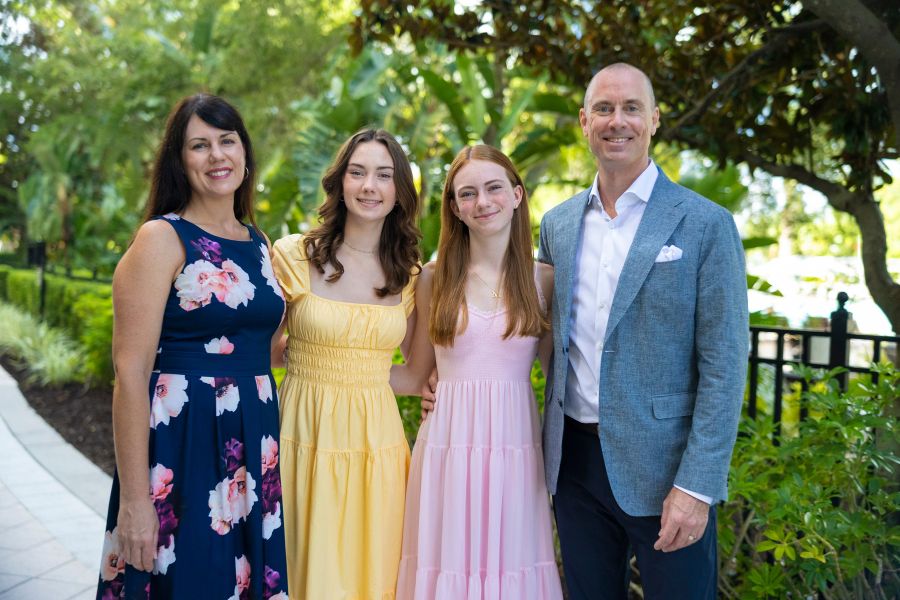
“In life,” Chris says, “all of our previous experiences contribute to who we are today.”
His own life experiences came down to three things.
First, growing up in a healthy, happy family environment — the kind where kids knew who they were, liked who they were, and were free to bike and kick soccer balls and roam the neighborhoods of Vancouver unafraid until suppertime.
Second, raising two young girls of his own, teaching them to believe in themselves, exercise their abilities, and trust in the love, support, and protection of their parents.
And third, managing people’s financial investments … a career requiring lots of cold-calling, a practical knowledge of what’s going on in the world, and an ability to communicate effectively with people exhibiting a wide range (depending on the market) of strong emotions.
“‘Our children are beautiful just as they are. No drugs or scalpels needed.’ That’s a message people can get behind.”
Chris Elston
Each of those experiences played a part in Chris’s decision to walk away from his life’s work and dependable income, hang a sandwich board on his shoulders, and step onto the nearest busy street to change the mind of a generation.
“I just felt like I had to,” he says. “I knew what I could do. I knew I could make a difference. It felt like a calling to do something … so, I did.”
“Chris is a dad, first and foremost, who woke up with a strong conviction that something must be done about the greatest child abuse scandal of our generation,” says Elyssa Koren, legal communications director for ADF International. “He just couldn’t live with not saying anything.
“He’s a strategic thinker, entrepreneurial, and he approaches his billboarding like a career. He’s very intentional about how he gets out there, how he spends his time and energy, because he knows that — literally — lives are at stake.”
“These are kids being turned into lifelong pharmaceutical patients,” Chris says. “They’ll never be able to have a family of their own. This is the very heart of evil. We simply had to start enough conversations to stop it.”
And those conversations, he knew, had to be in the real world.
“We’ve become so accustomed to speaking on social media that people don’t go to the physical ‘town square’ anymore,” he says. “On social media, you’re in an echo chamber. Most people never see those conversations. And mainstream media — even conservative media — weren’t talking about this.”
From the beginning, Chris says, “I came prepared to play the long game. I wasn’t starting off on a month-long adventure. I was going to keep at it until the job was done, even if it took my whole life.
“The people who are most successful are persistent. They don’t give up. This is about reaching one person at a time, one conversation at a time, and having faith that other people will come along and — when they learn about this — start fighting it as well.”

So: you want to change the world. Where to start?
“I just go outside,” Chris says. “It doesn’t really matter where. The more people, the better. Though it’s best if people are kind of stationary. If they’re going from Point A to Point B, they’re not as likely to stop and have a conversation. Parks can be good. Train stations, busy downtown centers, and, of course, universities.
How well does that work? Remarkably, five years of talking with ordinary people on public sidewalks has already ushered Chris into more elite company. He now divides his time between street corners and the halls of Congress … European parliaments … world economic forums … religious conferences and political conventions. He’s spoken, month-in and month-out, with people of all walks of life across the U.S., Great Britain, Ireland, Scotland, Belgium, the Netherlands, Switzerland, Portugal, Austria, and Australia, as well as his native Canada.
“You never know who you’ll run into,” he says. “There are only so many people in the world, so ultimately, this is just a numbers game. We have the truth on our side, and the truth spreads for free. We simply need to keep telling it and — to borrow a concept from the financial world — let compounding interest do its thing. Only, it’s conversations that are compounding, not money.”
“If I educate one person — and you double that — you reach two. Double it again. That’s four … eight … 16 … 32 … 64. Pretty soon, you’re at a million. As the awareness compounds, pretty soon you’ve got 5, 6, 7% of the population reasonably well-informed on this issue. That’s all you need.
“Any civil rights movement in history,” Chris says, “comes down to a few people leading the charge and a relatively small percentage of the population getting active in pushing for change.” He knows exactly which percentage he wants to activate.
“Primarily, we just need to reach parents. Nothing fires up a parent like bad people and bad ideas coming for their kids. This ideology is evil. It is harming our children, and the people pushing it are trying to usurp parental authority. We must not let this continue.
“People intuitively know that gender ideology is wrong,” he says, “but they’re afraid to say anything about it. Or don’t know enough to speak about it.”
That’s where Chris’s example and information — his conversations — come in.
“The sign is a conversation starter,” Chris says. Someone driving by glances over, or walking by, looks up and sees a sign that says, “Children cannot consent to puberty blockers.” Almost in spite of themselves, they ask, “What are ‘puberty blockers?’” They may go home and look up the answer, he says, or they may come back and ask him. Either way, they find themselves thinking about an issue they’d never considered before.
And that, Chris says, “generates ripples. And you never know where those ripples might lead.”
“He’s very intentional about how he gets out there, how he spends his time and energy, because he knows that — literally — lives are at stake.”
Elyssa Koren
The strategy hinges on three elements: 1) As mentioned, the sign must be displayed in an optimal place. 2) The sign itself has to draw attention. 3) The one carrying the sign has to seem approachable.
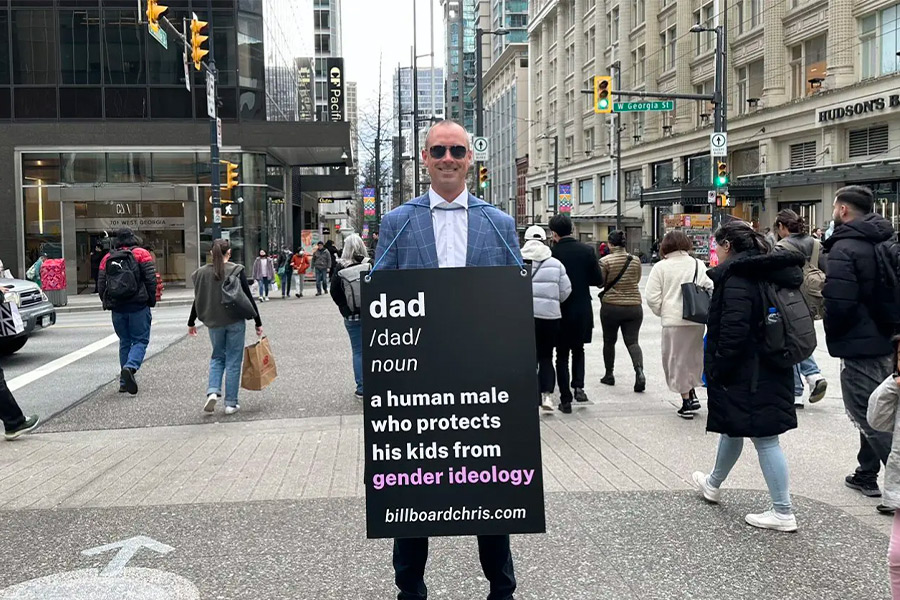
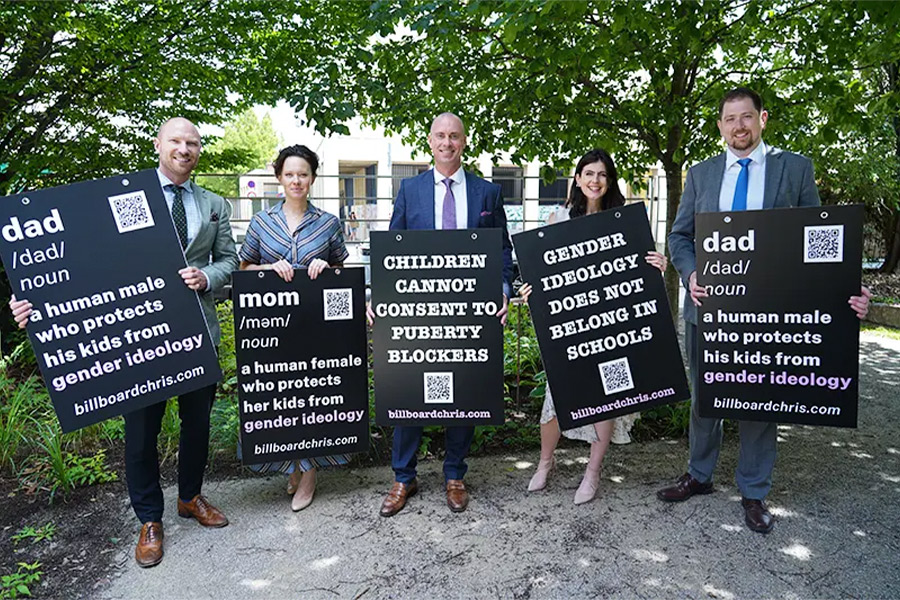
Chris carries four signs with him, to use in various combinations. He pairs two at a time to create a sandwich board, with one sign across his front and the other across his back.
Usually, the one up front is “Children cannot consent to puberty blockers.” That one, he says, tends to give people pause, because many don’t grasp what “puberty blockers” are. (They work chemically to prevent a child from developing the physical manifestations of puberty.) His second, “Dad: Noun: A human male who protects his kids from gender ideology” is especially popular, he says, with casual passers-by.
“What Chris does is expose how much of gender ideology rests on an absolute absence of truth.”
Elyssa Koren
He breaks out the other two signs when others join him on the street. “Children are never born in the wrong body” is a fast conversation starter, particularly with young people who’ve absorbed the opposite opinion from classrooms and pop culture. And “Gender ideology does not belong in schools” draws a lot of attention when Chris stands near a university campus.
To encourage pedestrians to stop and visit, Chris — 6-foot-2, with a shaved head — takes great care to appear inviting. “I make sure I dress well. You need to present yourself professionally if you want to get respect.” Because one person is less intimidating than a group, Chris usually works alone, but sometimes one or two others will join him. He has strict requirements, though, of those who do.
“We need to be impeccable in our behavior. You have to be able to stay calm — you can’t be yelling at people when they try to provoke you. You can’t be overly negative.
“You shouldn’t be swearing — that doesn’t help our cause.
“And keep the message positive: ‘Our children are beautiful just as they are. No drugs or scalpels needed.’ That’s a message people can get behind.”
A surprising number of people do, says Lois McLatchie Miller, senior communications officer for ADF International, who has followed along on the streets with Chris.
“In the average city, he gets about nine-to-one support,” she says. Often, “that’s someone just giving their little thumbs-up and a wink as they walk past.” Others stop to engage and encourage Chris, expressing their agreement, or wishing they could speak with his skill and authority about the issue.
“Chris is an excellent communicator,” Miller says, with “one of these minds that just absorbs all these facts and figures. But he’s also able to use the language people need, to help them articulate what it is that they want to say. You can get really angry about these issues when you see the harms being caused to kids. But Chris can channel that outrage into something that’s more of a positive message … which is why these billboards have been such a hit all over the world.”
Well … not quite all over the world. And not quite with everybody.
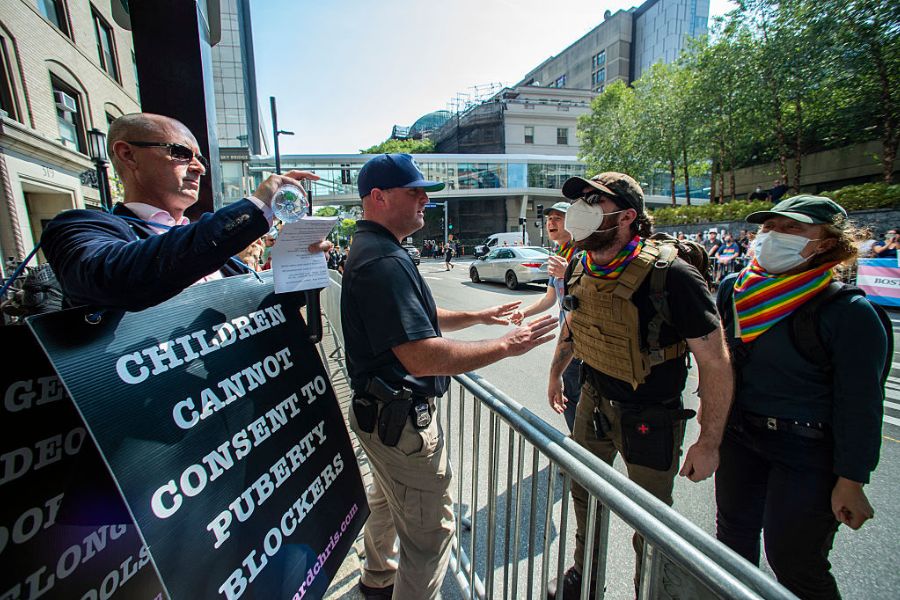
Over the years, Chris estimates he’s been physically assaulted more than 40 times. Shoved. Slugged. Sucker-punched. Hot coffee thrown in his face. In Montreal, a half-dozen people closed in one night, throwing punches, screaming obscenities, and swinging a heavy traffic pylon; the second blow broke his arm.
“People intuitively know that gender ideology is wrong, but they’re afraid to say anything about it. Or don’t know enough to speak about it.”
Chris Elston
“It’s going to happen,” he shrugs. “In a city with a million people, you’re going to get all sorts of things. It’s mostly supportive, but there are always going to be some who have a problem with me. A lot of them use violence to silence.”
Police aren’t always helpful. Chris has been arrested three times — twice, in Canada, after being assaulted; in both cases, he was charged with creating a disturbance for standing quietly, wearing his sign. Then, in Brussels, he was taken into custody after calling the police, when a sizeable mob began to close in. Officers strip-searched him, confiscated and destroyed his signs, then released him without filing any charges. In none of the cases were his attackers arrested.
Still, “we can’t let fear of violence stop us from speaking the truth,” Chris says. “Otherwise, this ideology continues. Most people who object to me are not in a headspace where they’re willing to accept the truth. Sometimes they’re violently acting out. But if I’m calm and they’re crazy, assaulting me, people who don’t know anything about this subject see me, dressed respectfully in a blazer, and some [other] person getting violent, aggressive, and angry … I’ve already won.”
“What Chris does is expose how much of gender ideology rests on an absolute absence of truth,” Koren says. “People really rebel because he comes armed with facts. He knows so much about the catastrophic implications of this ideology. About the actual physical effects of puberty blockers and cross-sex hormones, and all of these experimentations that children are subjected to.
“When people are forced to look at those facts — and the facts are often quite uncomfortable and even gruesome — they resist the messenger,” she says. “So many people have sanctioned this ideology or turned a blind eye to it.” Chris, with his facts, she says, “creates an enormous response from people. Maybe it’s guilt, that they’re letting this happen in front of their very eyes, and — by saying nothing — they’re basically approving it.”
“Every time they try to draw attention to what I’m doing — to stop what I’m doing on the street — all that does is make the message stronger,” Chris says. “All it does is make it reach more people. So, the more they try to stop me, the better, as far as I’m concerned.”

The most concerted effort to silence Chris came last year in Australia, where he inadvertently prompted a major legal action after learning that the World Health Organization had appointed an individual named Teddy Cook — a woman who identifies as a man — to its panel of experts on gender. Chris had read a Daily Mail article detailing Cook’s X-rated sexual proclivities, and posted the article on the social platform X, referring to Cook as a woman and criticizing her as unfit for such an appointment.
Australian authorities moved quickly to censor his post, led by the country’s “eSafety Commissioner,” an official charged with removing problematic content from the country’s social media platforms under the guise of “online safety.” The commissioner pressured X to take down the post down; X left it up but geo-blocked it in Australia — ensuring that Australians couldn’t see it until a hearing could settle the issue.
X and Chris — the latter with the legal support of the ADF International team and the Australian Human Rights Law Alliance — both sued, and both cases were heard together in a week-long hearing in Melbourne. Officials argued that their censorship was justified, calling what Chris had done “hate speech” and a violation of Cook’s rights. This, even though everything in the Daily Mail article was public information — and had been publicly disclosed by Cook herself.
Essentially, the commission was granting itself power to censor opinions it didn’t like — on a global scale. In a decision that made international headlines, the Australian tribunal ruled that the commissioner had overstepped her authority and violated Chris’s free speech rights.
“[His victory] just speaks to this enormous pushback that we have across the world,” Miller says, “where people are standing up and saying, ‘This is enough. We can’t hold in free speech anymore. We have to challenge this. This is not a local issue — it’s a global trend.”
“[His victory] just speaks to this enormous pushback that we have across the world, where people are standing up and saying, ‘This is enough.’ “
Lois McLatchie Miller
Cases like Chris’s, she says, “are all part of the same story: suppressing the right to speak the truth. Yes, the truth will always find its way out, but we must protect that right because it speaks into all these other important conversations that we must be having, in order to protect people … to advance human dignity … to help communities care for each other and flourish together.”
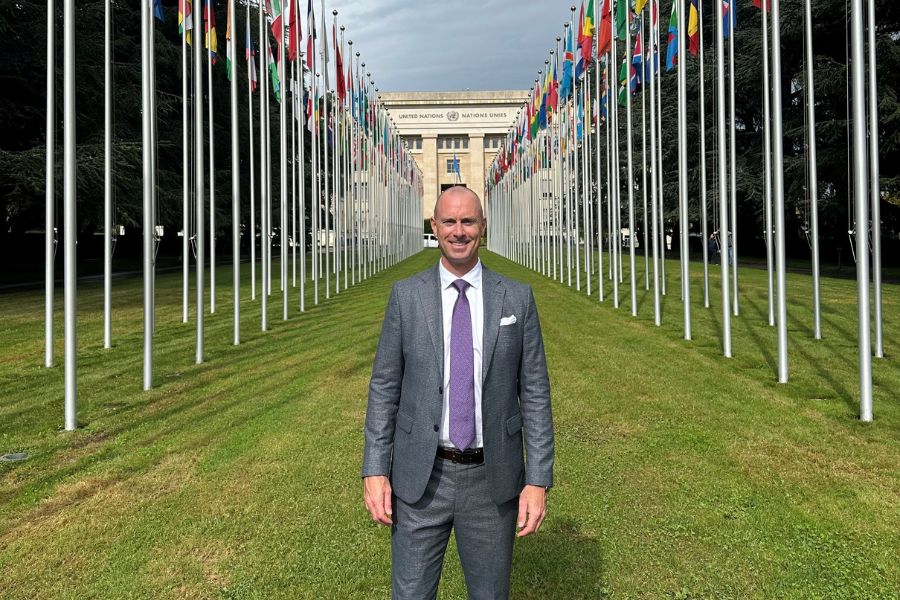
For all the physical attacks, arrests, and legal actions, Chris remains unswerving in his sense of his calling. “I don’t really worry about all the negativity,” he says. “You can’t. You just have to keep telling the truth.”
“He doesn’t do this casually,” Koren says, “and he doesn’t show fatigue. He has this complete willingness to wake up every day and start anew and just … keep going. He’s not overwhelmed by the enormity of the goal that he’s trying to accomplish. He’s actually invigorated by that.
“A lot of us,” she says, “could just look at the bleakness of the picture and kind of throw our hands up. But he’s a really excellent model of looking at a real crisis — one that often seems like it isn’t winnable in the short term — and approaching it with enthusiasm and a positive attitude.
“That’s why people respond so well to him,” Koren says. “Because he does believe that we’re winning, and he has the facts on his side.”
Chris now makes it a point to record his conversations, as they happen, and then publish the videos on social media under the moniker “Billboard Chris.” Not only the thoughtful conversations, but the violent ones, and the ones that end with him in handcuffs. At present, he estimates that his posts draw a billion views per year.
A billion.
That “compound interest” idea? It’s working.
“This is one of the most important causes of our day — and one of the greatest medical scandals of history. If we can’t speak about this … we can’t speak about anything.”
Elyssa Koren
“It’s pretty clear he’s been successful,” Koren says, “based solely off the premise that, when you ask someone, ‘Have you heard of Billboard Chris?’ more and more you get a very enthusiastic ‘yes.’ His message is not unique to him, but his delivery certainly is: engaging in viral street conversations wearing a sign.
“We know, at the end of the day, what people crave is face-to-face interaction. So, even though he uses the digital world to spread his message, he’s having these conversations in person. He’s affecting people at a personal level — he makes people think.
“This is one of the most important causes of our day — and one of the greatest medical scandals in history,” she says. “If we can’t speak about this — ending puberty blockers, hormone therapies, and horrific surgeries where children are getting their bodies changed in permanent, serious, harming ways — we can’t speak about anything.
“Chris’s energy and positive spirit really give people hope that we can win,” she says. “And, in fact, we are. We’re seeing wins across the world because of this positive message.”
From the beginning, Chris says, “I knew I was going to come under a lot of abuse and my life was going to change. People would try to cancel me and all that. But I know who I am, and my wife and daughters know who I am. And, ultimately, that’s all that matters.
“This is about the ideology itself and the harm being done to kids. I just stay focused on that.”
“Chris has done more than any other single human being to really make it clear to people that we have to take a stand against this,” Koren says. “With him, we’re working toward the moment where every child is safe from this extremely dangerous ideology.”
“I’m just a guy having conversations,” Chris says. “I had faith in humanity to stop this. I had faith that other people would come along to help me. That’s why we’re having so much success.”
Still, it’s important — in a world increasingly deaf to the cries and pain of children — to have someone out in front who understands sign language.

Chris Potts
Sr. Creative Writer & Editor
Related Articles