Key Takeaways
- Ryan is a Christian who wanted to share his faith with his fellow college students. He held signs, had one-on-one conversations, and offered tracts to those interested.
- Yuba College’s policies restricted speech, and the college threatened to punish—even expel—Ryan if he continued to express his faith on campus.
- Alliance Defending Freedom sued the college on Ryan’s behalf and negotiated a settlement to change the policies so Ryan and others could speak freely on campus.
Colleges are places of congregation and conversation. They’re places to meet friends, debate, and learn. But when college administration interferes with student expression, it not only harms the student experience but also violates students’ rights.
College administrators cannot act as arbiters of truth by selectively silencing or punishing students based on the views those students express.
But that is exactly what one college did to Ryan Dozier.
Meet Ryan Dozier
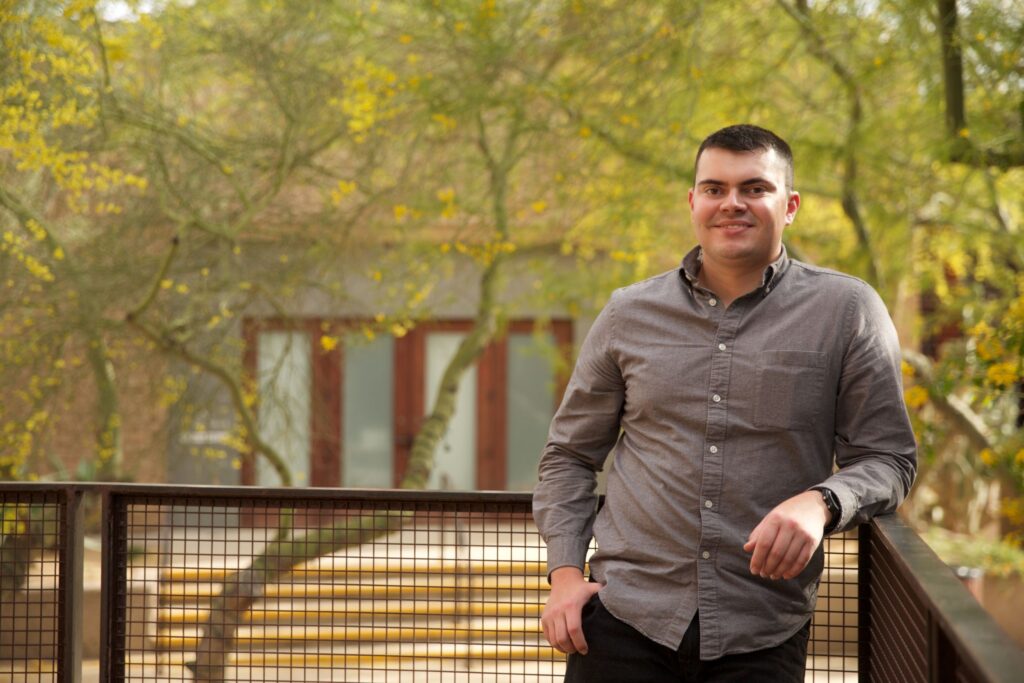
Ryan Dozier was a student at Yuba Community College who wanted to share his faith with his peers.
“…I believe that one of the tenets of my faith is to love others as myself,” Ryan said. He cared about other people, and one way Ryan did that was by sharing his faith with them.
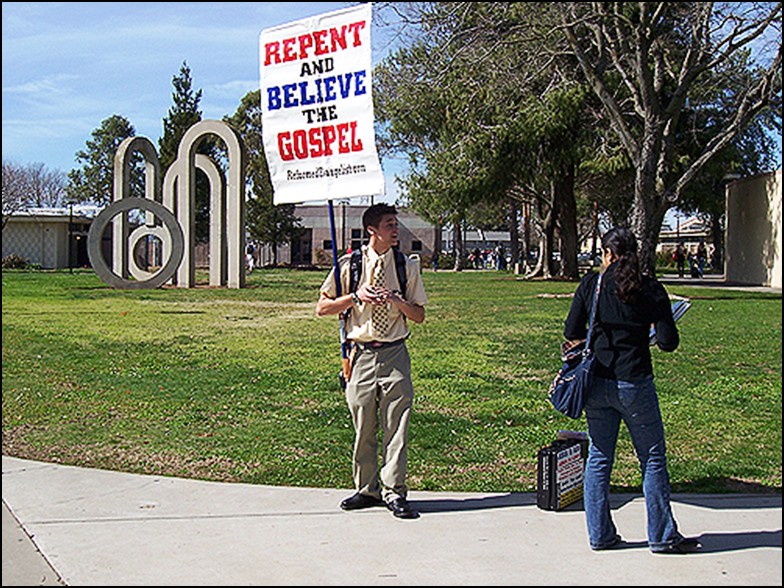
In an effort to fulfill his duty to share the Gospel, Ryan sought opportunities to speak with other students about his faith. Ryan often distributed Gospel tracts that can easily be placed by a recipient in a purse or pocket. Ryan also held up signs with religious references. And sometimes, Ryan sought to engage in open-air preaching on campus to generate discussions.
Told to stand down for sharing his faith
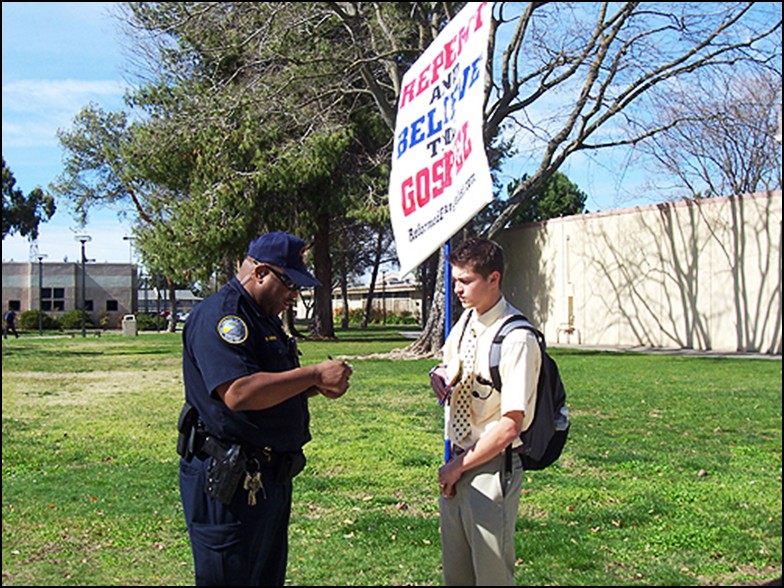
Around 12 p.m. on a Wednesday, Ryan positioned himself in the open, main area of campus near the library and stood off to the side of the sidewalk near the grass. He had a sign with him that said, “Repent and Believe the Gospel” on one side, and “Peace with God Only in Jesus Christ” on the other.
Ryan had cordial one-on-one conversations with multiple people who were walking by and handed them Gospel tracts.
“People were [free] to either take it or not. They could walk by without me infringing [on] them and without me blocking them to be able to go past me on the sidewalk,” Ryan explained.
But then a campus police officer came up to Ryan.
“He approached me and told me that I had to stand down, that I had to put away the sign and stop doing what I was doing. He said I was assembling without permission and that I could suffer not only suspension but be expelled from the school if I continued on in the behavior…” Ryan said.
The police officer told Ryan he’d need a permit from the college to conduct such an “assembly” and that he would be arrested if he didn’t stop immediately.
So Ryan agreed to take down his sign and stop sharing his faith with his peers.
A few weeks later, a certified letter from a college administrator reiterated the threat, advising Ryan that speech like his was allowed at Yuba only on Tuesdays and Thursdays between 12 p.m. and 1 p.m. with 14 business days’ notice.
The letter mentioned that Ryan had assembled without a permit and had to adhere to college policy if he wanted to hand out material or even speak to students. The letter served as a warning to not violate any policy and a threat that there would be “further discipline up to and including expulsion from the college” if Ryan didn’t do what the letter instructed.
Yuba Community College restricted student speech

The college’s policies restricted student expression.
The college campus had many open, accessible areas that resembled parks, pedestrian malls, and sidewalks. The outdoor, publicly accessible areas of the college campus had been opened up by the college for expressive use by students and others.
But the policy claimed the entire campus as a “non-public forum,” save for unidentified locations designated as “limited public forums.”
Further, Yuba Community College reserved the right “to revoke that [limited public forum] designation and apply a non-public forum designation at its discretion.” In other words, the policies gave the college the authority to decide if, where, and when students could speak.
That’s wrong. The streets, sidewalks, malls, and other publicly accessible outdoor areas of college campuses are public spaces where discussion should be able to happen freely.
Yuba also required students to get permission to speak 14 business days in advance. If permission was granted, the college allowed students to speak only from 12 p.m. to 1 p.m. on Tuesdays and Thursdays in a designated “speech zone.” Students also had to provide notice at least 48 hours in advance to hand out written materials.
The college’s policies required students to obtain a permit for expressive activity anywhere on campus. With this permit scheme, college administrators had unfettered discretion in determining where, if anywhere, student speech could occur.
Furthermore, the speech code conditioned punishment on how listeners reacted to speech, a subjective measure.
These policies prohibited speech that the Constitution protects and did so without giving students objective guidelines on how to act or requiring administrators to apply the policies objectively and precisely.
Ryan explained that this affected more than just him. “Not only did they infringe [on] my First Amendment right[s], but they also infringe [on] the rights of others to be able to freely speak on campus,” he said.
Ryan just wanted to express his faith on his college campus, but he kept quiet for fear of arrest or expulsion.
“I wanted to change the policies,” Ryan said. “I wanted to be able to freely speak on campus … to be able to share my faith, and I also wanted the ability for other students to do the same.”
ADF lawsuit prompts college to revise policies
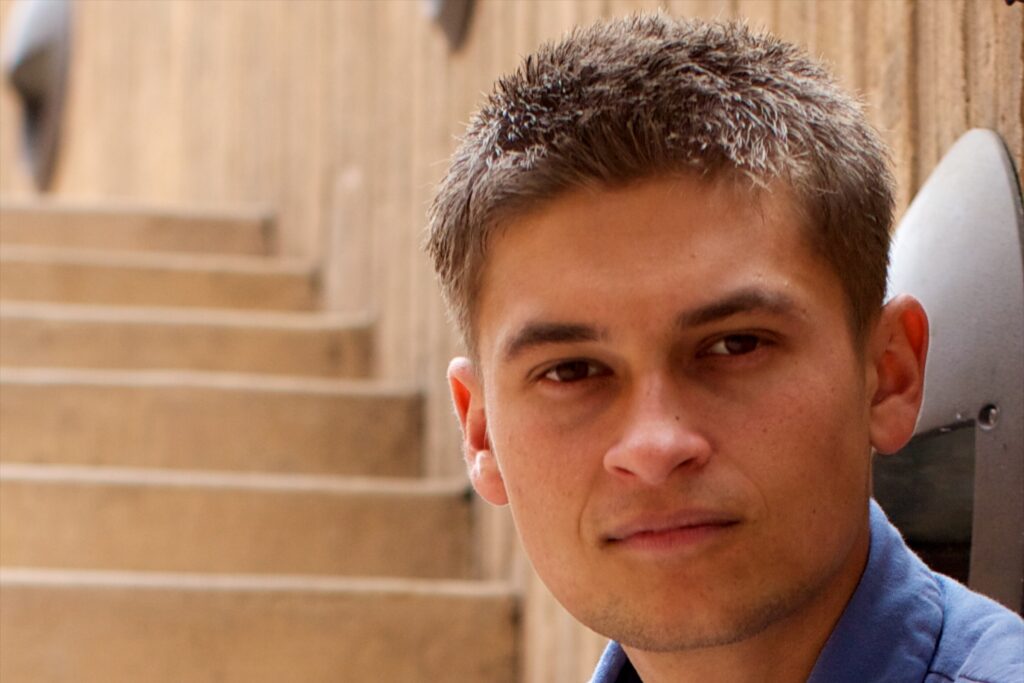
Ryan asked Alliance Defending Freedom to protect his right to speak freely on campus.
ADF filed a lawsuit on Ryan’s behalf in September 2008.
The college later revised its policies and shared the changes with students in December 2008. The changes eliminated the “speech zone,” opened the campus to student speech throughout the day, and ensured that Ryan could speak freely without fear of arrest.
ADF ultimately negotiated a settlement with Yuba Community College, which was agreed to in January 2009. Yuba also agreed to pay attorneys’ fees of $25,000 and nominal damages.
These policies were wrong from the start, but it takes the courage, conviction, and steadfastness of people like Ryan to make a difference for the better.
Not only did Ryan secure positive changes for himself through this settlement, but students at Yuba also benefited from these policy changes that respected free speech.
Defend free speech and religious freedom on campus
ADF is honored to stand with people who want to speak freely, including students like Ryan. Whether at school, in the workplace, in the digital sphere, or elsewhere, the First Amendment protects the freedom of speech and religious freedom.
Students have the freedom to share their beliefs on college campuses. Restricting conversations, including religious ones, through “speech zones” and overbroad policies is antithetical to the learning process and violates the Constitution. Free speech is essential for a flourishing society.
Dozier v. Houle
- February 2008: Ryan shared his faith on Yuba Community College campus, and a campus police officer told him he would be arrested if he didn’t stop.
- March 2008: Ryan received a letter from the college reiterating that he must follow the restrictive speech policies, or else he could be suspended or expelled.
- September 2008: ADF filed a lawsuit against Yuba Community College on Ryan’s behalf.
- November 2008: A federal judge ordered Yuba Community College to temporarily suspend enforcement of policies against Ryan.
- December 2008: Yuba Community College published the revised speech policies.
- January 2009: Yuba Community College agreed to settle, including the revised speech policies and paying $25,000 in attorneys’ fees and nominal damages.
Related Articles