

Key Takeaways:
- Teachers have a duty to speak up if they believe a school’s policy is harmful to students. They should not be punished for it.
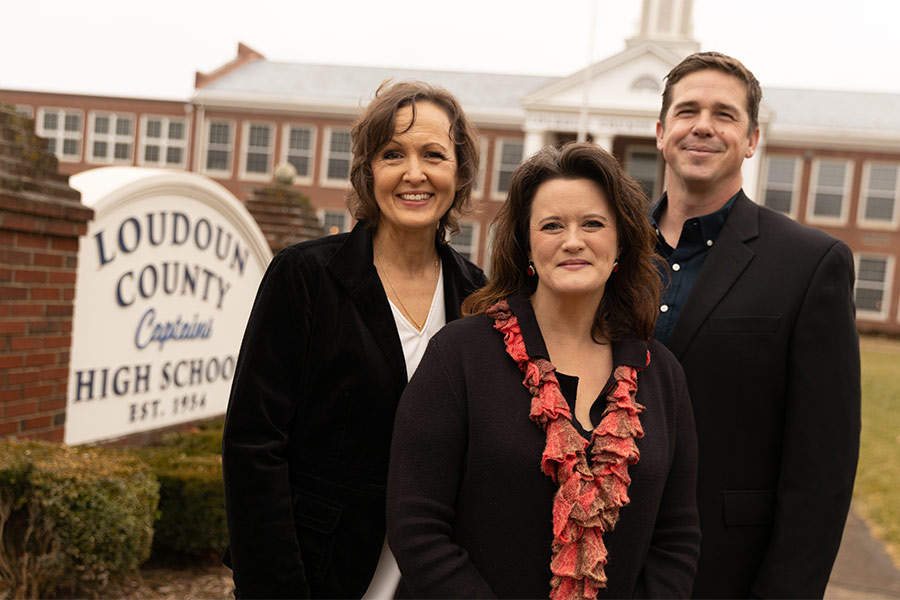
- Monica Gill, Tanner Cross, and Kim Wright are three highly respected educators who’ve never been subject to disciplinary action—until they spoke up.
- Teachers should not be forced to personally attest to ideologies they believe are false.
Teachers can assume a wide variety of roles at school. Some can teach you about the intricacies of trigonometry. Some teachers can help shape your grammar and sentence structure. Others can help you learn how to read a sheet of music properly.
But no matter what the teacher’s niche may be, all have a universal expectation to speak out if they have reason to believe a child could be at risk.
Whether it’s one student bullying another or the school administration imposing a harmful new policy, teachers are duty-bound to speak out on behalf of children and parents who may not be aware of every detail happening at their child’s school.
Yet when a trio of teachers in Virginia’s Loudoun County did just that, they were threatened by the school district.
Who are the Loudoun County teachers?

Monica Gill, Tanner Cross, and Kim Wright all taught in various schools within Loudoun County Public Schools. All three have extensive experience as educators and working with students. And all three also share one of the most important traits teachers can have: a commitment to educating children and serving them as they develop physically, mentally, and emotionally.
Monica Gill
Monica has had decades of teaching experience. Her educational journey would eventually lead her to Loudoun County High School, where she taught History. That has encompassed teaching everything from AP U.S. History to Sociology. Monica was also the History Department Chair.
In other words, Monica has worn many different hats as an educator—and has thrived in each.
Given that, Monica has unsurprisingly never been the subject of any school district disciplinary action. In fact, neither Monica, Tanner, nor Kim had ever been the subject of disciplinary action. Quite the contrary, Monica consistently received positive reviews for her role as a teacher. In one review, she was described as “a highly effective teacher who engages her students with her instruction.” A year before that, Monica’s review described her as providing “a very safe environment in which students can express their opinions and engage in debates, and this is managed extremely well.”
Unfortunately, Monica’s clear commitment to the growth and well-being of her students would eventually make her a target of the very school district she had faithfully served for all these years—just like some of her fellow teachers.
Tanner Cross
Tanner was a Health and Physical Education Teacher at Leesburg Elementary, also in the Loudoun County school district. Tanner was described in a review by his vice principal as “extremely professional” and an “excellent role model.”
The vice principal wrote: “Mr. Cross is an important and valuable member of our Leesburg Elementary community. He works well with our colleagues and is an active participant in school meetings.”
Kim Wright
Kim was a teacher at Loudoun County’s Smart’s Mill Middle School, where she taught a variety of subjects, from English to Computer Application. And just like Monica and Tanner, Kim received nothing but glowing reviews in her time as a teacher. Kim’s been described as a “lighthouse of positivity in a time of extreme negativity” and “a shining example of what it means to be a professional educator.”
Kim, Monica, and Tanner are all clearly respected teachers with a track record of excellence. And none of them had ever been the subject of disciplinary action. Yet when the three spoke out against a new Loudoun County school policy harmful to children, they weren’t lauded. They faced punishment instead.
What were Monica Gill, Tanner Cross, and Kim Wright standing up against?
In May 2021, the Loudoun County School Board began openly considering adopting Policy 8040, entitled “Rights of Transgender Students and Gender-Expansive Students.” The policy effectively allowed students to choose a different name and different pronouns “without any substantiating evidence, regardless of the name … recorded in the student’s permanent educational record.” The policy would also allow students to use restrooms and locker rooms based on their “gender identity” instead of their sex. Policy 8040 also revised an older policy, allowing students to participate in various sports based on “gender identity.”
Lastly, the policy required all staff “when using a name or pronoun to address the student, [to] use the name and pronoun that correspond to their gender identity.”
Monica, Tanner, and Kim understand that sex, not identity, is what makes a person male or female. As Christians, their faith teaches them that God immutably created each person male or female, and that these two complementary sexes reflect the image of God. They also saw the evidence of the harm that so-called “gender transitions” were doing to children across the country and around the world. To make them use pronouns that contradict sex is to make them tell a lie that’s harmful to children. That’s why Policy 8040 was a non-starter for Monica, Tanner, and Kim. At their core, Monica, Tanner, and Kim simply wanted to help protect children from making potentially irreversible and life-changing decisions that they may very well later regret.
That’s why Tanner was led to speak out against Policy 8040 as a private citizen during a public May 2021 school board meeting.
“It is not my intention to hurt anyone,” Tanner said during the meeting. “But there are certain truths that we must face when ready. We condemn school policies like 8040 and 8035 because it will damage children, defile the holy image of God. I love all of my students, but I will never lie to them regardless of the consequences. I’m a teacher but I serve God first.”
Leesburg Elementary did not put up with these comments. It swiftly retaliated against Tanner. Just two days after Tanner voiced his concerns about Policy 8040, Leesburg Elementary unceremoniously informed him that he was being placed on administrative leave. Why? Apparently, his calm and collected remarks at the public meeting constituted “conduct that has had a disruptive impact on the operations” of the school. Underneath the jargon, however, the immediate punishment’s message was clear: all employees who speak out against the policy would do so at their peril.
Because of this blatantly unconstitutional retaliation, Tanner quickly contacted Alliance Defending Freedom, which commenced legal action against Loudoun County School Board and other school officials. Upon hearing of Tanner’s plight, Monica and Kim would eventually join the suit as well, since their own religious objections to the policy put them under threat of punishment too.
What happened to the school district’s mandate?

Praise God, common sense—as well as Monica, Tanner, and Kim—would ultimately prevail, though it took something of a winding path. Shortly after ADF filed suit on Tanner’s behalf, the Loudoun County Circuit Court ordered his immediate reinstatement. And in August 2021, the Virginia Supreme Court issued an order confirming the reinstatement order, agreeing that the school district’s actions were likely unconstitutional.
A few months later, in December 2021, the school board agreed to a permanent injunction prohibiting it from retaliating against Tanner for his constitutionally-protected remarks. But the real progress came after ADF helped secure a major victory for free speech in Vlaming v. West Point School Board. In that case, ADF helped a high school French teacher, Peter Vlaming, successfully sue his school board after it fired him under a policy similar to Loudoun County’s.
The Vlaming win paved the way for the Loudoun County School Board to ultimately change its position on Policy 8040, allowing teachers like Monica, Tanner, and Kim to avoid violating their own beliefs. Then, in July 2025, the Loudoun County Circuit Court officially recognized that the school board no longer interprets Policy 8040 to force teachers to go against their beliefs.
A teacher’s convictions cannot be overridden by the government
Monica, Tanner, and Kim never asked for a fight. They asked to do their jobs—to educate, to protect, and to serve the students in their care the way they had always done. What they got instead was retaliation, legal battles, and years of uncertainty, all because they refused to affirm something they believed, in good conscience, to be false and harmful to the very children they were sworn to serve.
That is what government-compelled speech looks like in practice. It isn’t abstract. It has faces, careers, and livelihoods attached to it. When a school district punishes a teacher for speaking out at a public meeting—a meeting specifically designed for public input—it isn’t just targeting one employee. It’s sending a message to every teacher in the building: fall in line or face the consequences. That kind of institutional intimidation has no place in a free society, and it certainly has no place in a classroom.
Teachers are entrusted with something precious: the minds and well-being of the next generation. That trust cannot coexist with a mandate to personally attest to ideologies that teachers believe are harmful to the students sitting right in front of them. Monica, Tanner, and Kim were vindicated, but their ordeal should never have happened in the first place. No teacher should ever be forced to choose between their convictions and their calling, yet it keeps happening.
Will you stand with teachers like Monica, Kim, and Tanner? Your gift today will help ADF continue standing by teachers and educators whose constitutional rights are being violated.
Related Articles