Free speech is often described as a settled principle in the West—secure, expansive, and resilient enough to withstand disagreement. Yet in recent years, a quieter challenge has emerged through location-based speech restrictions.
Across the United States and the United Kingdom, governments have increasingly carved out so-called “buffer zones” or “censorship zones,” physical spaces where certain forms of expression are restricted or prohibited altogether, under the guise of protecting a marginalized group.
Troublingly, U.K. “buffer zones” have a specific target: They restrict free speech around abortion facilities comprising the distance of one and a half football fields. People are running afoul of the law simply by praying or wanting to converse outside of abortion facilities in the U.S. as well.
“Buffer zones” have now become a common way for authorities to silence disfavored voices. Perhaps most alarmingly, the issue is not confined to one country or legal tradition. It’s become a real issue in two countries where freedom is supposed to be sacred.
U.K. stifles prayer with Public Spaces Protection Order “buffer zones”
Despite Britain’s long-standing commitment to civil liberties, authorities have increasingly used vague and murky orders to restrict lawful prayer and expression in public places.
Dr. Livia Tossici-Bolt
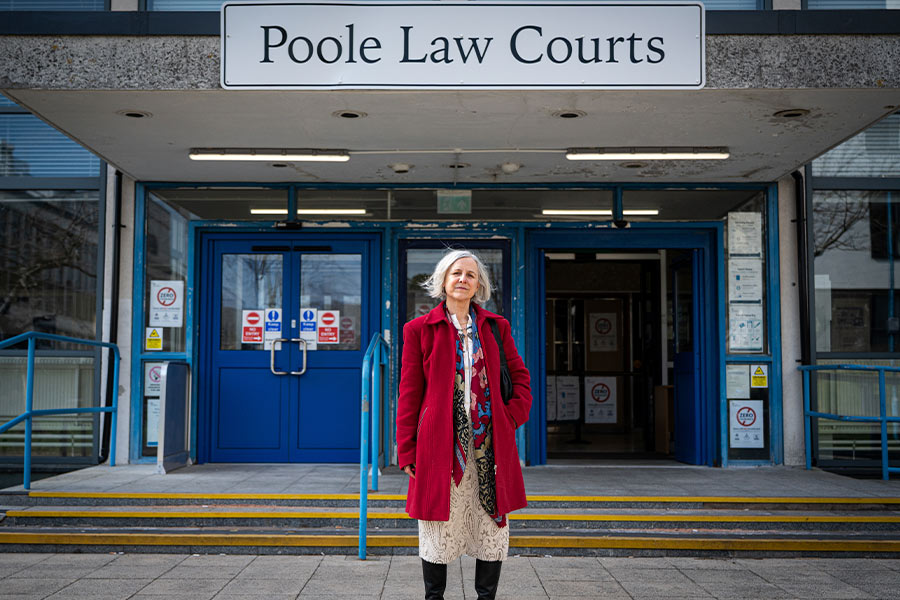
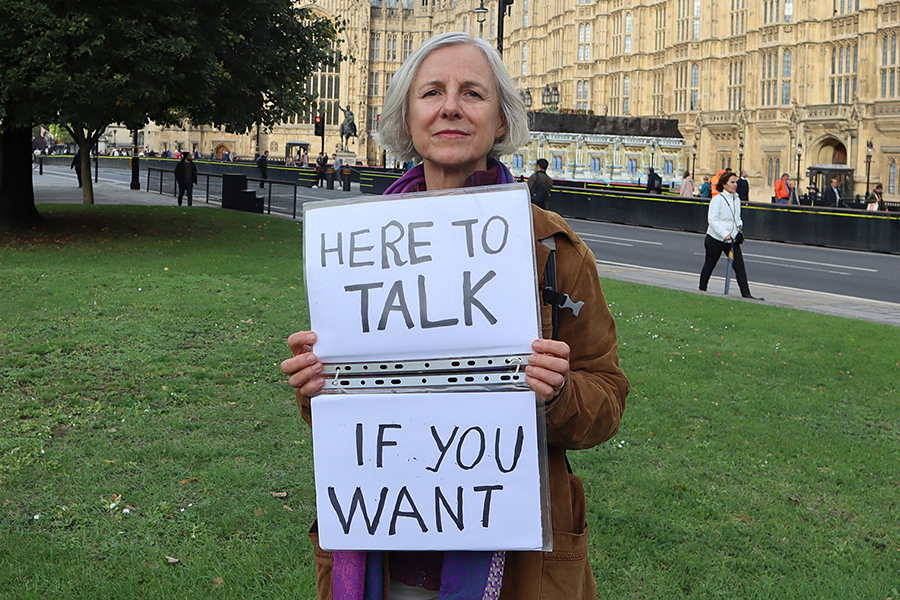
Dr. Livia Tossici-Bolt, a 64-year-old former medical scientist, noticed that the social restrictions put in place during the COVID-19 pandemic were having a very negative effect on people in England. But she also noticed a glimmer of hope: People were also going out in public to simply interact, whether that’s with hugs, conversations, or other forms of encouragement.
She wanted to do the same. So, Livia took a sign that read, “Here to talk if you want,” and went to a public street near an abortion facility in Bournemouth, England. This led to countless positive interactions, from parents wanting to speak about their child to students wanting to talk about their studies. One person even invited Livia over for tea.
But, the Bournemouth Council officials in charge of patrolling the zone took great issue with Livia’s conversations. In fact, they issued Livia a fine for allegedly violating a “buffer zone.”
The zone sought to prevent people from expressing “approval or disapproval” of abortion within 150 meters of the Bournemouth abortion facility. But Livia’s conversations were doing nothing of the sort. Because she was doing nothing wrong, Livia refused to pay the fine.
Livia was then dragged into a trial, and even though the officers involved in the incident couldn’t cite a single complaint of people saying they felt harassed by Livia’s presence (nor was her sign in any way related to abortion), a magistrate court found her guilty and ordered her to pay £20,000.
Livia has appealed this verdict, and ADF International continues to support her legal defense.
Unfortunately, this isn’t the only violation of freedom stemming from Bournemouth.
Adam Smith-Connor
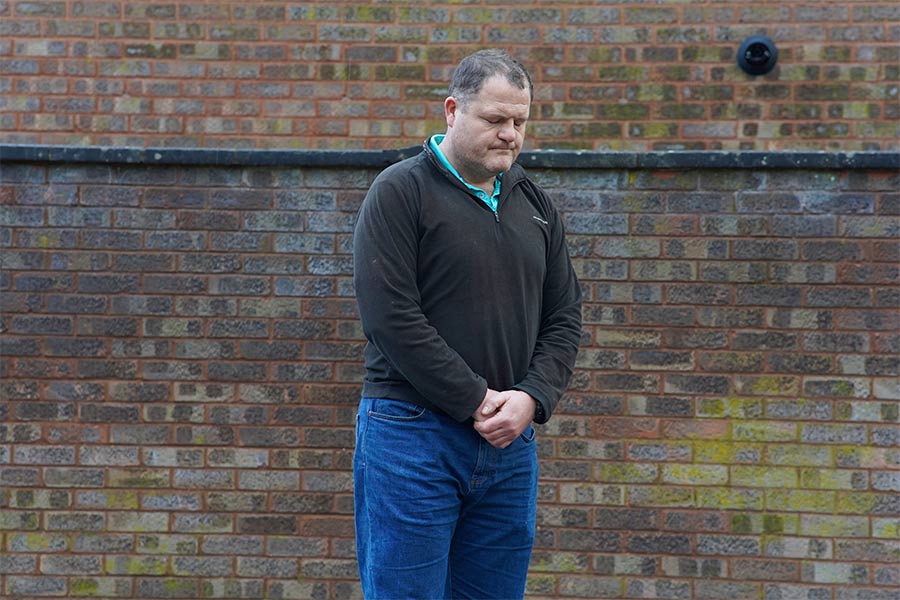
Army veteran Adam Smith-Connor has also personally experienced the “buffer zone”-related censorship that is rising in the U.K. A veteran of the British Army Reserves who admirably served his country in Afghanistan, Adam chose to silently pray outside of a Bournemouth abortion facility. He had his back to the building to make it clear that he was not trying to disrupt anyone’s privacy.
Adam was praying for his son, whom he had lost to abortion years ago. He was also praying for any men and women who were facing difficult decisions about abortion. Despite praying silently and not disrupting anyone, local officers accosted Adam and questioned his actions.
Unbelievably, one officer even asked, “What is the nature of your prayer?”
The officers found that Adam was in violation of a “Public Spaces Protection Order,” which created a “buffer zone” prohibiting prayer, counseling, and other acts or “approval/disapproval, with respect to issues related to abortion services.” In other words, Adam was being punished for a thoughtcrime.
Adam was ultimately criminally convicted and ordered to pay a £9,000 fine simply for praying in the silence of his mind—a gravely unjust punishment.
As U.S. Vice President J.D. Vance put it during a February 2025 conference in front of world leaders in Munich, Adam was charged “with the heinous crime of standing 50 meters from an abortion clinic and silently praying for three minutes, not obstructing anyone, not interacting with anyone, just silently praying on his own.”
It’s a gravely unjust punishment. ADF International is supporting Adam’s appeal.
Isabel Vaughan-Spruce
Isabel Vaughan-Spruce was originally acquitted of praying silently outside of an abortion facility. ADF International supported a legal defense that involved not one, but two arrests stemming from Isabel’s silent prayer outside of abortion facilities.
Authorities eventually admitted that they had treated Isabel unjustly and agreed to pay £13,000 for violating Isabel’s human rights. Despite that admission, Isabel was charged again recently for praying outside of an abortion facility.
Despite not mentioning anything about prayer, a new national law prohibits“influencing any person’s decision to access, provide or facilitate abortion services” within 150m of abortion facilities. Guidance on the law even stipulates that silent prayer on its own is not enough to meet the threshold of criminality unless it is accompanied by “overt” activity.
“Despite being fully vindicated multiple times after being wrongfully arrested for my thoughts, it’s unbelievable that I have yet again been charged for standing in that public area, and holding pro-life beliefs,” Isabel said. Silent prayer – or holding pro-life beliefs – cannot possibly be a crime.
“Everyone has the right to freedom of thought.”
Isabel is 100 percent correct, and that is why ADF International is supporting her through this unbelievable ordeal.
The U.K. could learn from some of its neighbors
Thankfully, there have been some positive legal decisions on this front recently elsewhere in Europe.
Take Germany and Austria. Those two countries have recently affirmed what the U.K. has not: that peaceful prayer is a right, not a crime, with courts in both countries rejecting attempts by authorities to ban prayer vigils near abortion facilities and making clear that freedoms of assembly, expression, and religion do not vanish in so-called “sensitive” public spaces.
- In Germany, a court struck down police-imposed 100-meter “buffer zones” after a prayer group, backed by ADF International, challenged the restriction.
- And in Austria, judges overturned a ban on a planned vigil by the youth pro-life group Youth for Life, ruling that peaceful prayer is lawful assembly that cannot be excluded from public space on religious grounds.
Together, the decisions send a broader message across Europe: public spaces are not reserved for one worldview, and authorities cannot bar peaceful citizens simply because they disagree with their religious expression. The U.K. would do well to take a closer look at these rulings.
“Buffer zones” allow the U.S. government to silence disfavored voices
Despite the First Amendment protections on free speech in the United States, the government has found ways to attempt to circumvent those enshrined rights.
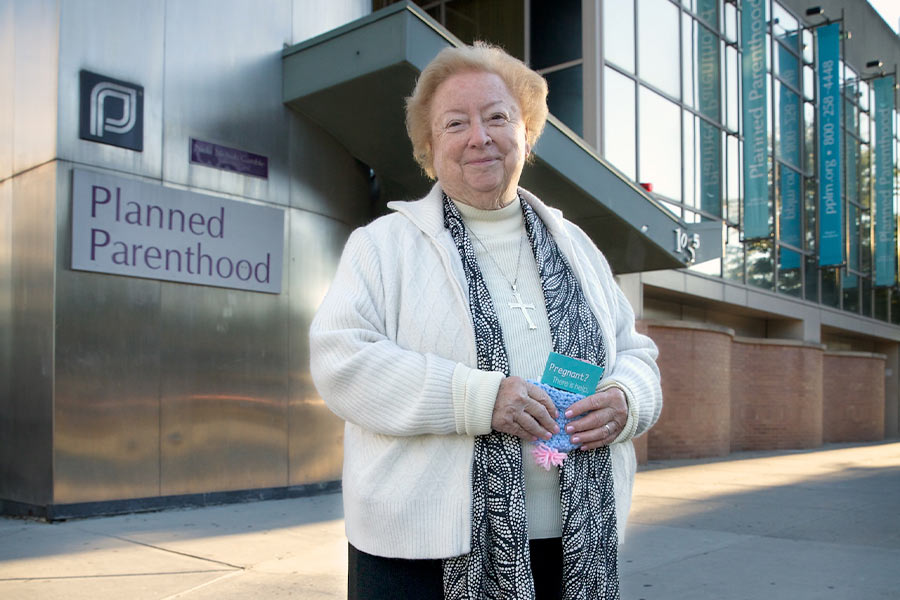
Eleanor McCullen
Most Americans would agree that “buffer zones” that restrict free speech would clearly violate the First Amendment. But in 2007, Massachusetts passed a law that did just that. The law created a 35-foot “buffer zone” restricting speech around abortion facilities.
This law blatantly hamstrung peaceful pro-life advocates like Eleanor McCullen.
Two days a week, Eleanor would stand on the sidewalk outside a Planned Parenthood in downtown Boston. “I am called a sidewalk counselor. I like to offer hope, help, and love,” Eleanor says. She would speak to the women, trying to persuade them to choose life and informing them of resources available.
Despite the incredible good that Eleanor was clearly doing, Massachusetts created a fixed “buffer zone” around abortion centers by amending its Reproductive Health Care Facilities Act of 2000. This meant that pro-life advocates were required to keep at least 35 feet away from building entrances, exits, and driveways.
Because of this, instead of approaching with kindness and compassion, the law tried to force Eleanor and the other counselors to shout at the women and men to get their attention, giving the impression they were there to condemn, not help, the women and men and their unborn babies.
Alliance Defending Freedom supported Allied Attorneys who worked on behalf of Eleanor to challenge the new “buffer zone” statute. Litigation against the Massachusetts attorney general went on for eight years, finally reaching the Supreme Court in early 2013.
Thankfully, the Supreme Court ruled unanimously in Eleanor’s favor in 2014.
Right to Life of Central California
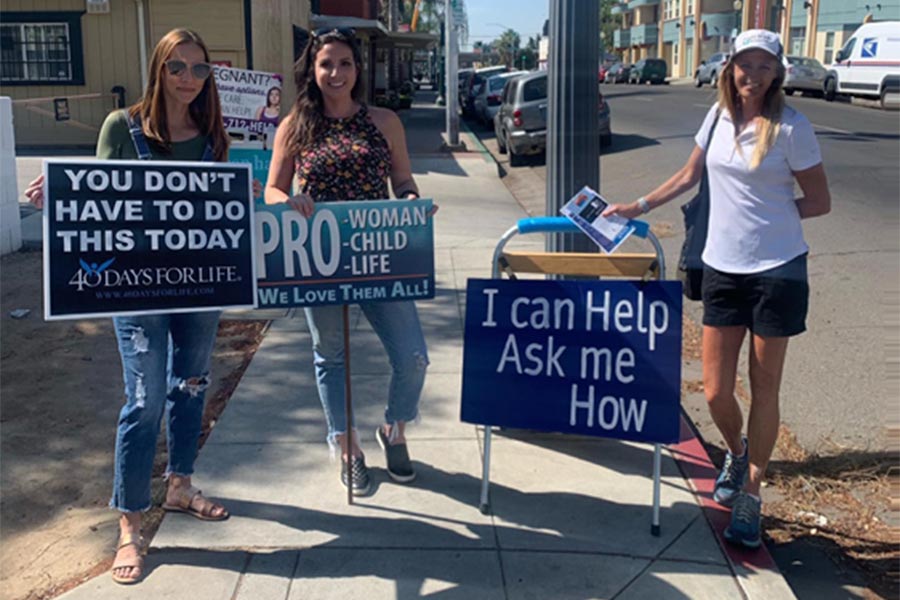
In California, Gov. Gavin Newsom signed a law in 2021 that banned certain speech activities within 30 feet of any place that offered any kind of vaccines. That unconstitutional law impacted pro-life groups.
California’s law created 30-foot “buffer zones” within a 100-foot radius of places offering vaccines. If a person was within 100 feet of one of these vaccine sites, the law banned him or her from speaking certain messages to anyone within 30 feet.
Instead of applying the law only to sites that were offering the COVID-19 vaccine, California inexplicably applied the law to places offering any type of vaccine. This included a Planned Parenthood facility in downtown Fresno offering HPV vaccines.
That broad application negatively affected Right to Life of Central California, a nonprofit that serves women facing unplanned pregnancies or grieving due to abortion. Part of the group’s mission involves sidewalk counseling, which was suddenly under threat due to Newsom’s law.
Because of that threat, shortly after the law was signed, ADF filed a lawsuit on behalf of Right to Life challenging these unconstitutional restrictions. In July 2022, a federal district court ruled that Right to Life was likely to succeed on its claim that California’s law violated the First Amendment, and the court barred California officials from enforcing the discriminatory parts of the law against Right to Life while the lawsuit proceeded.
Following this ruling, California officials agreed to a permanent settlement stipulating that they would not enforce the discriminatory parts of the law against Right to Life or any other speaker. They also agreed to pay $192,706 in attorneys’ fees, and ADF dismissed the lawsuit.
The FACE Act
Not unlike “buffer zones,” the FACE Act—passed by Congress in 1994—purports to help protect the marginalized or underserved. In practice, however, it’s been twisted to silence voices the government disfavors. The law protects people from injury, intimidation, or interference when they provide or seek out so-called “reproductive health services,” which include services at abortion facilities or pregnancy centers, or exercise their right to worship. More specifically, the act bars the use or threats of force, obstruction, and property damage intended to disrupt religious worship or the administration of reproductive health care services.
Despite the fact that the FACE Act was meant to protect both abortion providers, pregnancy centers, and religious worshippers, the Biden administration weaponized it to go after pro-life advocates far more than to protect people of faith. In fact, under the Biden Department of Justice, for the first time in the FACE Act’s history, it was used as a hook to tack on an additional “conspiracy against rights” felony charge. This charge comes with a potential ten-year prison sentence—even for nonviolent civil disobedience.
“Buffer zones” set a dangerous precedent against freedom
What makes “buffer zones” so troubling isn’t just their breadth, but their intent: they transform peaceful prayer, quiet counseling, and offers of help into punishable offenses. When the state treats such acts as a public threat, free speech is no longer a protected right but a conditional privilege—one that exists only so long as it aligns with official approval.
Once “buffer zones” are normalized, the principle at stake doesn’t stop at abortion facilities. The idea that the government can carve out entire swaths of public space where certain viewpoints are forbidden should alarm anyone who values civil liberties. Criminalizing prayer or compassionate outreach is not about safety or order; it is about suppressing disfavored expression, and history shows that once speech is fenced off, the fence rarely stays in one place.
“Buffer zones” should more properly be called “censorship zones,” because instead of protecting free speech, they silence dissenting viewpoints.
That’s why ADF will stand with those who’ve had their free speech rights violated by these so-called “buffer zones.”
Related Articles