


It’s terrible, the far-reaching damage one gunshot can do.
It’s been six decades since a generation of young people watched their heroes — two Boston brothers and a Baptist pastor from Georgia — shot down in the prime of life, at the height of their national influence. The impact of those assassinations has echoed on and on, in our culture and campaigns, shadowing our hopes as a people and our optimism as a country.
Last year, a new generation experienced that pain, as another shooter took out another young man whom a growing number of high school and college students looked to as a hero — for his courage, his faith, and his bold willingness to speak piercing truth to their age group. Gabby Stout was one of those young people.
“Charlie Kirk became really popular for teenagers like me,” she says. “He was very smart. I’d see him on social media, or watch him as he went to campuses, speaking to the students, and think, ‘Wow, he’s talking about God, talking about the Bible.’
“I liked what he said. He spoke truth to campuses. He wanted people to be able to defend their faith and what they believe in. He debated students, but he’d welcome them, even if they weren’t from the same background or didn’t agree with him.”
“I was really distraught. I’d never seen someone assassinated. And many other students were so obviously sad.”
Gabby Stout
“I don’t think people understand the impact he had on this generation,” says Gabby’s mother, Kristin. “To have someone invest their time going to speak to students, and he did it in a very respectful way.” She says Gabby’s enthusiasm for Kirk began in middle school, when she joined her two older sisters in following his videos and podcasts for Turning Point USA.
“She really, really loved watching him,” Kristin says. “That day he died, when we saw the assassination and just the horror of it all, she right away said, ‘I need to do something.’”
“I was really distraught,” Gabby says. “I’d never seen someone assassinated. And many other students were so obviously sad.
“I wanted to give people hope that, even though Charlie Kirk died, he was defending what he believed in. And he went up to heaven because of his faith in Christ. I wanted to share that message of truth and hope with people.”
Her parents could understand that. “We said, ‘Figure it out. Come back to us,’” Kristin remembers. “‘We’ll support you 100% in whatever you want to do.’ And that’s how the rock came about.”
The rock … and a persecution more swift, painful, and unreasonable than anything Gabby could have imagined.
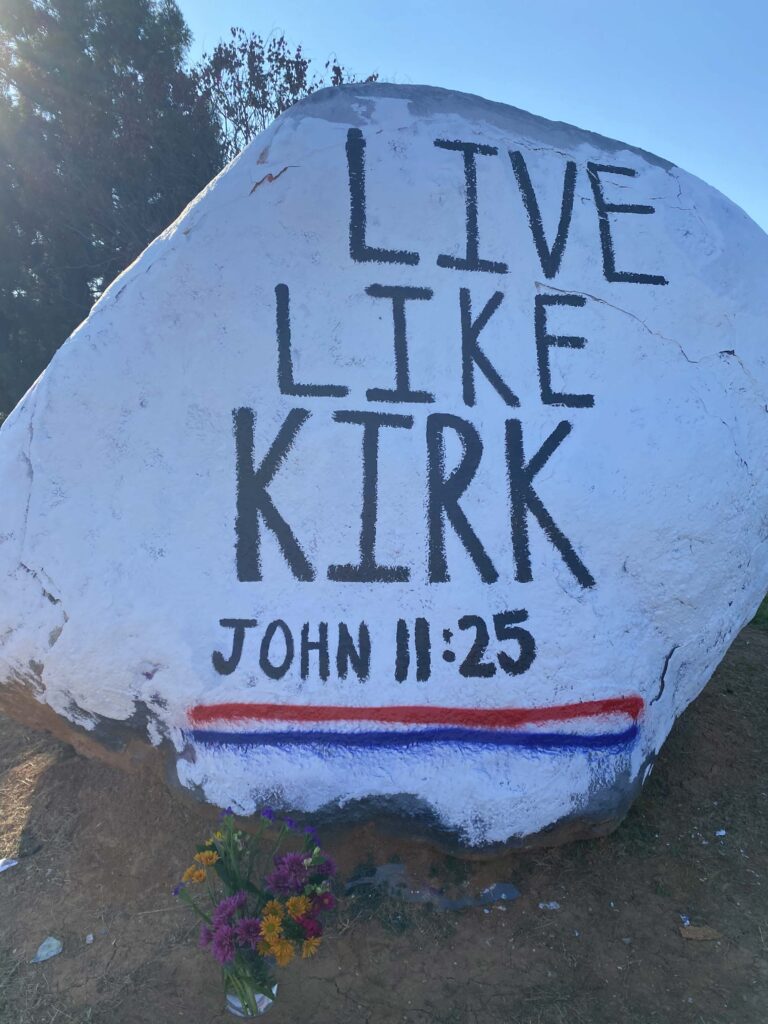

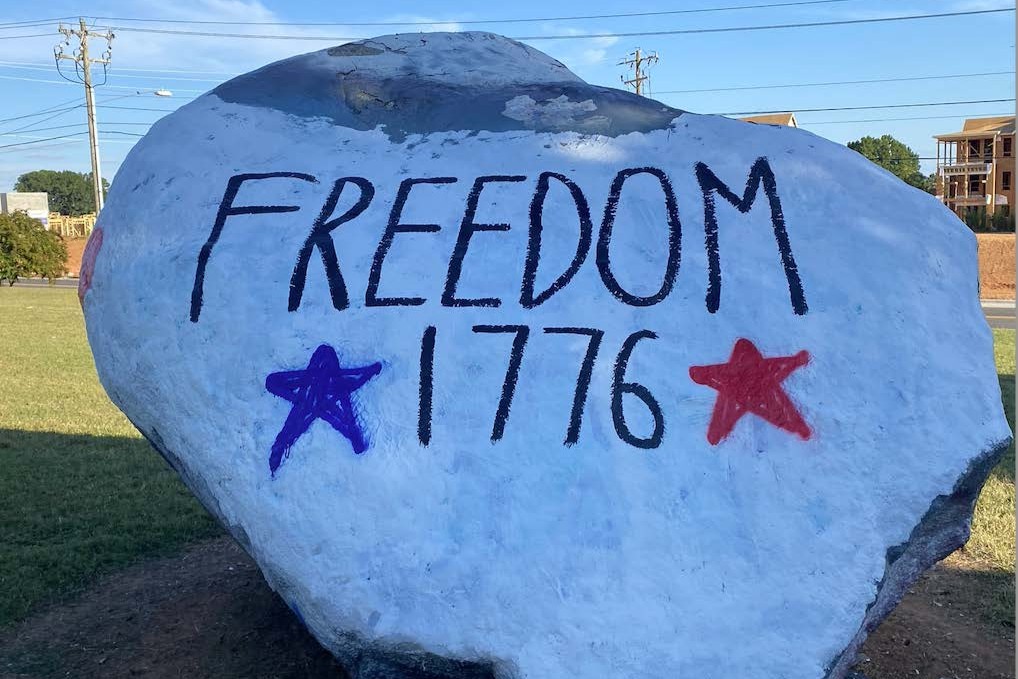
The “spirit rock” is a sizeable (seven feet high, 10 feet wide) boulder placed near the entrance of Ardrey Kell High School in Charlotte, North Carolina. It has been available over the years for students wanting to paint messages for their peers — celebrating team wins or special occasions, teacher appreciation or general encouragement, and, from time to time, even messages of a more political nature. (In recent years, administrators reportedly removed pro-Trump messaging but allowed pro-Biden and Black Lives Matter slogans.)
In the days immediately after Kirk’s assassination, a number of communities across the United States and internationally offered tributes: marquees and vigils, memorial services, public statements by officials, flags hung at half-mast. Charlotte, though, did nothing, as far as Gabby could tell. That sparked an idea: “I want to paint the rock,” she told her parents, “and set up a memorial so other people will come and honor him.”
“I thought, ‘What could I paint that told what Charlie Kirk also stood for?’” Gabby remembers. “I wanted to paint something patriotic.” That became an American flag and the words “Freedom 1776.”
“I also painted ‘Live Like Kirk,’ because he stood for God, family, country, and defended what he believed in.”
Finally, she painted the reference, “John 11:25,” which says, “I am the resurrection and the life. Whoever believes in Me, though he die, yet shall he live.” A message of hope, Gabby says, “that Charlie Kirk died, but he’s still living eternally in heaven.”
“Gabby’s not into politics. She loved Charlie’s message, how he loved his country. She liked that someone was standing up for Christ.”
Kristin Stout
Now knowing what she wanted to say, Gabby decided she’d better be sure she could say it. Was there a fee for painting the rock? A form to fill out? A review of the school’s website revealed nothing, but just to be sure, her parents suggested calling the school office to ask permission. They listened as the woman Gabby spoke with assured her there was no fee, no form.
“That would be very nice,” the woman said after Gabby explained her plans.
So, on the Saturday afternoon following Charlie Kirk’s death, Gabby, her parents, and two of her friends braved the hot summer sun for two hours, painting her message. Gabby set a bouquet of flowers at the base of the rock, hoping they might inspire a few other memorial bouquets.
That didn’t happen. Almost before the paint finished drying, most of her message was gone.

Not all of Gabby’s work vanished — just “Live Like Kirk” and “John 11:25.” A friend texted to say she’d seen school officials painting over those words. Gabby and her dad, Steven, drove back to the school; sure enough, there was a patch of gray where her message had been.
Gabby was surprised “and a little hurt.” When someone had painted over a Black Lives Matter message years before, the school had quickly repainted it and warned students about covering up any messages on the rock. Now, not only was her message half-erased, but school officials themselves seemed to have erased it. Why?
“We didn’t think it was controversial in any way,” Steven says.
“This is a 17-year-old girl,” Kristin says. “She’s not into politics. She loved Charlie’s message, how he loved his country. She liked that someone was standing up for Christ.”
Although Gabby knew not everyone agreed with Kirk’s views, “I thought a lot of people would probably have empathy,” she says, “that this man — a father and a husband — got shot, no matter what side they were on.”

Sunday afternoon, she found out otherwise. Every Ardrey Kell family received an email from the principal.
“We are aware that the spirit rock in front of our school was painted this weekend with a message that was not authorized or sponsored by the school or the district,” the email read. “Acts like these are considered vandalism to school property and are in violation of the CMS [Charlotte-Mecklenburg Schools] Code of Student Conduct. Law enforcement has been contacted and we are cooperating with the investigation.”
Reading the email, Steven and Kristin gasped. “This is a huge mistake,” they thought, urging Gabby to reach out at once to the principal. She did, with an email explaining everything. No reply. Tears and fears welled up rapidly, as she dreaded what she might be in for the next morning. A hefty fine? Long-term suspension? Criminal punishment? It didn’t help that the story aired that night on local news stations — none of which contacted the Stouts for comment.
Still, “once these people hear our side of the story, it’s going to get all cleared,” Kristin kept telling her daughter … and herself.
Unfortunately, that wasn’t true.

In many ways, life has been especially kind to Gabby. A talented athlete who’s not ashamed to admit she’s “really, really good” at field hockey, lacrosse, and pickleball, she’s the third of three sisters who do what they can to make their younger brother’s life difficult. The close-knit family enjoys movies, cards, and swimming after church on Sundays. An excellent student, Gabby is taking the tests for in-state universities and looking toward a future in business or real estate.
Then, a month before the rock-painting, she was diagnosed with Crohn’s disease. Weeks of great pain, serious illness, and a major surgery short-circuited some of her teenage carefreedom. She was just recovering enough to plunge into the joys of her junior year when her would-be tribute to Kirk threatened to bring the roof down on everything.
The roof — and Gabby — were already trembling by the time she reached school Monday morning. There, several of her usual comrades told Gabby and her fellow rock artists they wouldn’t be walking into class with them that day.
“We had to walk in alone,” Gabby remembers. “We were so scared as it was.” The desertions hurt. So did the stares, glares, and murmurs from her classmates, less than an hour later, as a teacher ordered her to report to the front office.
An assistant principal coldly ushered her into an empty conference room, where a pen and notepad were lying on the table. “Write down what happened,” she said.
“I was shaking,” Gabby says. “I couldn’t even hold the pen.” She managed to scribble down the story behind the painting and what she’d written there. The administrator looked over the paper, then pushed it back. “You forgot to add what else you wrote.” Still shaking, Gabby stared at her blankly. Looking back down at the paper, she realized she’d forgotten to include “John 11:25.”
“Yeah,” the administrator said, cryptically. “I think that’s the most important thing.”
Gabby had never been called to a principal’s office in her life. On her way back to class, she paused at the girls’ bathroom and cried. She hadn’t been back at her desk long when the same administrator walked into the classroom, demanding to see her again — with her cell phone. Back in the office, she third-degreed the girl, while another administrator ordered Gabby to surrender her phone so she could scan through it.
Terrified and confused, it never occurred to Gabby to ask to talk to her parents. She knew she hadn’t done anything wrong — surely, at some point, school officials were going to see that. But as the interrogation dragged on, she and her two friends (each enduring the same treatment) began to realize that wasn’t true.
One school administrator told Gabby, “You need to learn from this,” while another claimed Gabby’s message was political. Not one school administrator asked Gabby or her friends why they’d painted the message in the first place.
“I was shocked that people had so much hate in their hearts … that it had gotten this far and big.”
Gabby Stout
About that time, Kristin and Steven arrived, after seeing negative messages on social media directed to Gabby. An assistant principal had called, wanting to ask them some questions; she mentioned that Gabby had been forced to write out a statement. Alarmed, they hurried to the school to check on their daughter.
“Oh, my goodness,” Kristin thought, “what has she written out? She’s under a criminal investigation. Are they going to use this against her in a court of law?” In the office, she and Steven demanded a copy of the statement and a meeting with Gabby herself, now “white as a ghost,” Kristin remembers, and a puddle of tears.
“I was just so overwhelmed with what was happening,” Gabby says. “My mom said, ‘Do you want to come home?’ And I wanted to, but I said, ‘I don’t want to look like I’m running away from this. I didn’t do anything wrong.’”

Clearly, school officials didn’t agree. “She made a mistake,” the assistant principal said. “And hopefully she learns from this.”
“I really don’t think they cared what Gabby meant by what she wrote,” Steven says. “They viewed it in their way and didn’t like, I guess, the reference to Kirk and the Bible verse.”
“I started feeling very sick to my stomach,” Kristin says. “I realized, ‘They don’t care what her intent was. They’re out to get her, and they’re going to go after her hard. They want to make an example of her.’”
A conference call that afternoon with the principal gave them a moment of hope. She seemed genuinely interested in learning the truth. “We’ll get this all resolved,” she promised.
Meanwhile, the school district was scrambling to rewrite the rules on student expression. Tuesday night, the school put out a revised spirit rock speech code that explicitly forbade painting “political” or “religious” statements or symbols on it. Instead, the school would require all messages to “reflect positive school spirit and uphold inclusive values,” to express “school-spirit and good news,” and to be in “good taste.”
None of those terms were in any way defined — they would be open to the interpretation of administrators, on a message-by-message basis.
Between her phone records and the school’s, administrators soon knew that Gabby had not vandalized anything, nor intended to … nor had she been trying to make a political statement. The criminal investigation was closed, but no one made an announcement at school, or sent another email to parents, or contacted local news stations to clarify the girl’s innocence.
Instead, the school issued false public statements, claiming they’d never investigated Gabby for anything. Her presumed guilt hung in the air as friends avoided her, strangers stared, and Instagram and Facebook hummed with slurs and even death threats. Kristin warned her to keep an eye on the rear-view mirror while driving home.
“I realized, ‘They don’t care what her intent was. They’re out to get her, and they’re going to go after her hard.’”
Kristin Stout
“I was really scared,” Gabby says. “I didn’t know if these people knew where I lived. I was shocked that people had so much hate in their hearts … that it had gotten this far and big.”
Her parents, meanwhile, kept pressing school and district administrators, demanding their daughter be cleared.
“We just slowly went up and up and up and up the ladder,” Steven says, until the superintendent bluntly told them that Gabby’s innocence was never going to be acknowledged, announced, or clarified.
“That’s when we said, ‘OK, we’ve been trying to play nice. Now, ADF is getting involved.’”

The Stouts had been praying about that decision, and “we felt that God was calling us to be bold and not to live in fear,” Kristin says. “It would have been easy to remain silent, but, like Paul says in Romans 1:16, ‘I am not ashamed of the Gospel.’ That’s what led us to take action.”
Still, they left the final call up to Gabby. She didn’t hesitate. “I didn’t want this to happen to another person,” she says. “If calling a lawyer would prevent it, then I was ready to take those steps.”
The family contacted ADF attorneys, who immediately agreed to represent them in a lawsuit against the CMS district. But a funny thing happened on the way to litigation: Ardrey Kell administrators did a spectacular high dive into a pool of hypocrisy.
Only two months after putting Gabby through an ordeal over what she had painted and issuing a new speech code outlawing “political” statements, administrators threw their support behind a schoolwide protest against Immigration and Customs Enforcement operations in the Charlotte area.
Not only did Gabby’s principal formally approve a mass student walkout, she sent an announcement to all parents, assuring them she was working with the student leaders of the protest to ensure its success. “We are proud to support your right to expression,” she told the protesters.
An estimated 21,000 students across the CMS district skipped school as a result of the ICE operations. Many joined the ICE protests that school officials helped promote and facilitate, and none were penalized for expressing their political viewpoint.
“If it weren’t for double standards, that school district wouldn’t have any standards at all,” marvels Travis Barham, senior counsel with the ADF Center for Academic Freedom. “You’d think these administrators were trying to violate as many constitutional rights as possible, as quickly as possible.”
“It was just a litany — a veritable parade — of unconstitutional actions.”
ADF Attorney Travis Barham
School officials, he says, repeatedly, blatantly violated the First Amendment — not only by censoring Gabby’s message and silencing her religious expression, but by adopting overnight a new, viewpoint-based speech policy — one giving the school itself power to approve messages its administrators liked and to nix messages they didn’t.
They also violated the Fourth Amendment by failing to read Gabby and her two friends their rights before forcing them to write confessions and by searching Gabby’s cell phone, Barham says. What’s more, the forced confessions violated the girls’ Fifth Amendment protections against self-incrimination.
“It was just a litany — a veritable parade — of unconstitutional actions,” he says. “The school district is without excuse.”
The district’s attorneys apparently figured that out once ADF attorneys filed the Stouts’ complaint.
“They wanted to settle very, very quickly,” Barham says. “More quickly than I’ve ever seen in any other case.”
Within months of the rock incident, district officials agreed to issue a public statement clearing Gabby of any wrongdoing, apologized for what they’d put her and her family through, and adopted a new, constitutionally valid student speech policy. They also agreed to pay $95,000 in damages and attorney fees.
“People don’t pay $95,000 as ‘go-away money,’” Barham says. “These officials don’t have a leg to stand on. Hopefully, this will be a lesson to the district and to other schools that these kinds of ‘mistakes’ are very expensive.
“Gabby wasn’t trying to pick a fight. She was just expressing her views. That’s what Americans do: we speak our minds — freely. We have the constitutional protection to do that. These school officials reacted poorly, and Gabby and her family did exactly what they needed to do, which was to say, ‘You can’t treat us this way. You have to obey the laws of the Constitution just as much as everybody else does.’
“I wish more families and more students had the boldness of Gabby,” Barham says. “She’s obviously willing to speak out on the issues near and dear to her heart. Yet she does so in such a winsome way. She’s the proof that courage is its own reward.”

This has strengthened our family,” Kristin says. “You don’t know what your faith is until it’s tested. I prayed all night long over this child, for months at a time. Just prayed. We said, ‘Lord, You love her more than we do, so You need to protect her through this.’ And He did.”
But He not only showed the Stouts more of Himself in this crisis, her parents say. He showed them more about Gabby, too.
“Gabby is our goofy child,” Kristin says. “She loves to make people laugh. I didn’t realize how strong she is, until her sickness last summer, and then going through this with the rock. We’re amazed. Watching your child go through something traumatic as this … I just had so much fear because of the crazies that are in our world.
“But multiple times, Gabby would say, ‘Mom, God’s got this. It’s all OK. He’s going to deliver us.’ To have my child say that to me … wow. Her faith is strong in the Lord. When I was weak, she was very strong.”
“She’s not little Gabriella anymore,” Steven says.
“She’s much more than that.”

Several times over the last few months, Gabby says, her mother has asked, “Do you regret painting the rock?”
“No, I don’t,” Gabby told her each time. “I would do it again. I’ve been through a lot, but it’s worth it for God — and Charlie Kirk, to honor him.”
Still, there were low points. At Christmastime, Gabby was sitting alone in the school gym, thinking too much about too many things. Suddenly, a teacher — one she didn’t even know — appeared beside her. She handed Gabby a gift.
“I want to let you know,” the woman said, “that many of us are watching you. You just need to stay strong in your faith.” She turned to walk away. “Keep fighting the fight,” she said.
The gift turned out to be a necklace, inscribed with Jeremiah 29:11: “For I know the plans I have for you, declares the LORD, plans to prosper you and not to harm you, plans to give you hope and a future.”
Gabby Stout has both. What’s more, she’s taught a lot of people some hard things about freedom — and courage — they never really grasped before. Charlie Kirk would’ve understood.
Some people … you just have to paint them a picture.

Chris Potts
Sr. Creative Writer & Editor
Related Articles