
If there’s one thing that’s clear in the abortion debate, it’s the lack of agreed-upon definitions. Arguments for and against abortion tend to revolve around definitions. When does life begin? What is a person? What does viability mean?
Definitions are powerful. They don’t just categorize and clarify; they advocate and argue. In other words, definitions are not neutral.
Consider H.L. Mencken’s famous definition of Puritanism—“the haunting fear that someone, somewhere, may be happy”—which only reinforced inaccurate conceptions of what the Puritans believed. Or the popular maxim of feminist activist Marie Shear that feminism “is the radical notion that women are people.” It’s a powerful line: who could deny that women are people?
Those of us in the pro-life movement must understand what we stand for. And that starts with defining the term “pro-life” itself. When we call ourselves “pro-life,” what are we saying? What does “pro-life” mean?
Merriam-Webster defines “pro-life” as “opposed to abortion.” While that much is true, it’s a narrow and simplistic definition. Let’s explore a more complete understanding of what it means to be pro-life.
Where did the term ‘pro-life’ come from?
Even before the U.S. Supreme Court decided Roe v. Wade in 1973, advocates were using “life” language in the abortion debate. In 1967, a group of doctors, lawyers, and others banded together to encourage California Gov. Ronald Reagan not to sign a pro-abortion bill. The advocates called themselves the Right to Life League.
Two years after Roe was decided, the United States Conference of Catholic Bishops finalized a document called the “Pastoral Plan for Pro-Life Activities” affirming the dignity of all human life and setting an agenda for education, pastoral care, public policy, and prayer.
The use of the term “pro-life” continued to grow during the 1970s as advocacy on behalf of the unborn became a major political force. In Before Roe v. Wade: Voices that Shaped the Abortion Debate Before the Supreme Court’s Ruling, Linda Greenhouse and Reva Siegel of Yale Law School write, “When conservatives of the New Right began to assemble a pan-Christian coalition against Roe in the late 1970s, the crusade against Roe would proceed under the banner of ‘pro-life’ and ‘pro-family.’”
The term has stuck.
Pro-life vs. pro-choice
People who support abortion-on-demand are often described in the media as “pro-choice.” It’s a convenient term. The word “choice” has few negative connotations, and saying you are for something engenders much more sympathy than being against something. It’s why abortion activists don’t say they are “anti-life.” Sometimes a truth-in-advertising approach hurts the brand.
But “pro-choice” is simply not an accurate term for supporters of legalized abortion. First, the term fails to answer an important question: what choice? The answer, of course, is the choice to abort an unborn child.
But there’s another problem with the term “pro-choice”: it treats abortion as the only choice available to women facing unplanned pregnancies or uncertain futures.
People who call themselves “pro-life” support choices too: parenting and adoption are choices not just accepted but championed by pro-life advocates.
- Pro-life organizations such as Heartbeat International have affiliates that are licensed adoption providers.
- Lifeline Children’s Services facilitates the adoption process both domestically and internationally.
- Others, like the Radiance Foundation, promote adoption through education and awareness campaigns.
- And many more, including the March for Life, celebrate National Adoption Awareness Month in November.
Can the same be said for “pro-choice” organizations? Between July 2023 and June 2024, Planned Parenthood, America’s largest abortion provider, performed 187 abortions for every one adoption referral. Does that sound like an organization dedicated to “choice”?
Ironically, it is the pro-life advocates who are truly “pro-choice.”
And that definition brings us to another question.
Does ‘pro-life’ just mean ‘pro-birth’?
A common complaint of pro-abortion activists is that people who are pro-life are merely “pro-birth.” In other words, their interest in protecting life extends only to life in the womb. But this argument is a strawman.
Research from the Charlotte Lozier Institute shows that there are roughly 8,800 pro-life pregnancy centers that helped administer all sorts of aid even beyond pregnancy, including more than 4 million HIV tests. There are also entire networks of pregnancy centers that help empower women, like the 3,800 pregnancy centers under Heartbeat International, and another 1,200 centers under Care Net.
Those organizations don’t just preserve the lives of unborn children; they provide mothers with diapers and baby outfits and offer them parenting classes and prenatal education programs.
As the facts about adoption providers and the statistics about pregnancy centers indicate, pro-life advocates care for more than just the unborn.
Is ‘pro-life’ anti-woman?
Another fallacious argument employed against pro-life advocates is that they are really “anti-woman.”
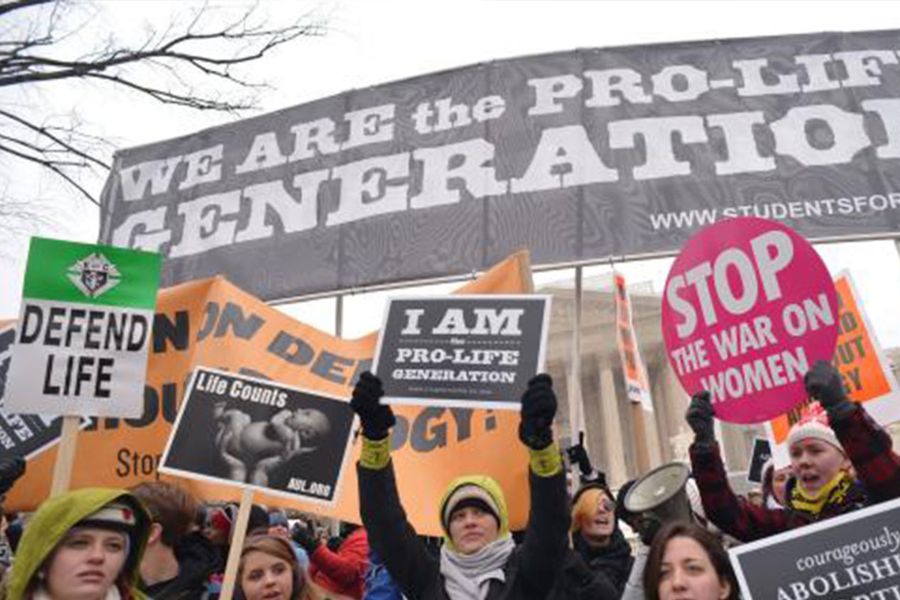
In 2024, the March for Life—the annual gathering of hundreds of thousands of pro-life advocates in Washington, D.C.—chose as its theme “With Every Woman, For Every Child.” The March is held each year to mark Roe’s anniversary, but in 2024, the March featured pregnancy centers and their tireless work to support women and families in unplanned pregnancies.
Language that characterizes pro-life advocacy as “anti-woman” often comes with a startling assumption: that women cannot be mothers and lead happy and successful lives. Of course, that conception is not only false; it’s also, ironically, anti-woman.
Furthermore, many of the pro-life laws Alliance Defending Freedom has defended have included provisions designed to protect and support women.
Consider Hodes & Nauser v. Kobach. In that case, Planned Parenthood and other abortion providers are challenging the Kansas Woman’s Right to Know Act. The law was passed by the state’s legislature to protect expectant mothers and includes a number of commonsense provisions.
For example, the law requires that abortion providers inform women seeking abortions about the risks of the procedure, the medical assistance available for prenatal and postnatal care, and the right to see an ultrasound of their child. It also includes a 24-hour waiting period to allow women to consider their options and not be pressured into undergoing an abortion.
Pregnant women deserve health and safety—and they don’t forfeit that protection when they consider having an abortion. But it’s not Planned Parenthood standing up for them; it’s pro-life advocates.
Being pro-life in all of life
Now that we’ve established what the pro-life movement is not, let’s also note how much more it is—and should be.
Pro-life means being pro-woman and pro-man
Part of being compassionately pro-life means recognizing the pivotal roles both fathers and mothers play in a child’s life, while also acknowledging the stories behind those men and women.
A mother is woven into the whole story of her unborn baby’s life. After all, a woman and her child are literally inseparable the entire time the baby is in the womb. She nourishes him, and he moves within her; he is continuously nestled where he can hear her heart. Her assumptions about life and her experiences will affect how she thinks about her child and how she parents.
But there is more to this story: every child also has a father who is responsible for that child’s well-being. And he too brings his assumptions and experiences into how he treats his child and the mother of his child.
It is essential for the pro-life movement to address the stories and the needs of both women and men in creating a culture that truly values all life. Yes, being pro-life means you value the life of the unborn child. It also must mean you value the lives of the men and women involved in creating that child. From the moment of conception, children belong to their parents, and the parents deserve care and compassion, too.
Pro-life means being pro-action
There are innumerable compassionate ways to promote life for father, mother, and child: good storytelling, serving at pregnancy centers, drafting and defending laws that promote healthy families, reforming the media, challenging lies in academia and philosophy, or simply listening to and being there for your brothers and sisters who are struggling—the list goes on.
Simply put, the pro-life movement needs to act when it comes to caring for the least of us. Inaction can only hurt. This has become such a deeply entrenched issue that mere lip service won’t be enough.
Think of the active role that pro-abortionists play in this debate. There are nearly 600 Planned Parenthoods across the country, and the organization receives billions of dollars each year. That sort of pro-abortion sentiment requires an equal and proportionate response.
Pro-life means defending life until its natural end
It is not just unborn children whose lives are in dire need of protection. Sadly, our culture often devalues the lives of the elderly and infirm as well.
In recent years, proponents of assisted suicide have sought to expand access to this deadly practice throughout the United States—and beyond. In Canada, for example, legalized euthanasia and assisted suicide account for about 1 in every 20 Canadian deaths, totaling over 15,000 people.
As in the abortion debate, activists use positive-sounding language to make their cause sound noble. “Assisted suicide” becomes “death with dignity.” But there’s nothing dignified about assisted suicide. The practice targets the vulnerable and the sick and harms those who need competent, compassionate care.
Creating a culture of life
ADF is committed to fostering a culture of life where the dignity of all human beings is protected. The most vulnerable among us—from the unborn to the elderly and the terminally ill—are worthy of life and protection under the law.
Life should be protected from fertilization to natural death.
Related Articles