
Could you go to jail for posting a meme? That seems like an absurd question straight from a dystopian novel. But unfortunately, the state of Hawaii enacted a law that criminalized posting satirical digital content such as memes.
That’s why The Babylon Bee, a popular Christian satire website, joined forces with Hawaii voter Dawn O’Brien to file a lawsuit challenging this draconian law. And in a victory for the First Amendment, a federal district court ruled that the law was unconstitutional.
The Babylon Bee is ‘Fake News you can trust’
When then-presidential candidate Donald Trump popularized the phrase “Fake News” in 2016, he of course wasn’t talking about satirical websites. But websites that create faux headlines for a comedic effect have been around since the dawn of the internet. And satire itself is as old as the written word.
From the Ancient Greek Aristophanes to Jonathan Swift’s “A Modest Proposal” in the eighteenth century, the art of slightly distorting facts about real events, people, and institutions doesn’t just make for good comedy. It’s also an important means for critiquing society and—more importantly—the government.
The Babylon Bee calls itself “Fake News you can trust,” and it has been putting a Christian twist on satirical news since 2016. The Bee does what all great satirists do—comedically distort real events and people by using irony and exaggeration as a way of telling a certain truth about them.
But some government officials tried to censor The Babylon Bee and similar websites. They passed a law to force disclaimers on posts and otherwise ban obvious and relevant critiques.
Of course, readers do not need the government to tell them that headlines such as “Senator Hirono Demands ACB Be Weighed Against A Duck To See If She Is A Witch” or “Dems Solemnly Don Tinfoil Hats Before Questioning Barr On Mueller Report” are satirical. These laws veer far into the realm of censorship, plain and simple.
If the government gets involved in telling us what is and isn’t true, it not only kills the joke but also harms everyone’s right to free speech. Unfortunately, The Bee has had to defend its right to post satirical content—even to the point of filing lawsuits—since its founding.
Hawaii Law Chills Speech
The latest challenge to free speech The Babylon Bee faced came from the Aloha state.
In July 2024, Hawaii enacted a new law, S2687, that imposed criminal and civil penalties for posting digitally modified content that risks “harming the reputation or electoral prospects of a candidate in an election or changing the voting behavior of voters in an election.”
The broad and vague language of this law meant that you could face lawsuits, damages, fines, and, yes, even jail time for posting political memes on social media. These vague terms are simply codewords for censorship and have the effect of chilling speech.
Hawaii has essentially made political memes a crime. We shouldn’t trust the government to decide what is true in our online political debates.
This was censorship and a clear violation of Hawaiians’ First Amendment rights. Websites like The Babylon Bee would have been forced to censor themselves or place disclaimers on many of their stories—ruining the jokes they’re trying to make.
Not only that, but allowing government officials and people who dislike our views to run to court and sue us for posting memes criticizing politicians would have chilled speech. Sometimes the process is its own penalty. Laws like Hawaii’s might be framed as protecting the truth. In practice, they’re about protecting politicians from criticism.
Freedom of Speech is Freedom to Criticize the Government
This isn’t the first time The Babylon Bee has challenged anti-free speech laws in court.
“We’re used to getting pulled over by the joke police,” said The Babylon Bee CEO Seth Dillon. In 2024, The Bee challenged two California laws that similarly banned certain political speech online. Both of these laws were passed after California Governor Gavin Newsom posted on social media that a parody video of then-Democratic nominee for president, Vice President Kamala Harris, should be “illegal.” Thankfully, in August 2025, a federal court ruled that California’s laws were unconstitutional.
And once again, in January 2026, another court struck down Hawaii’s censorship law.
Hawaii court blocks state’s satire censorship law
“Political speech, of course, is at the core of what the First Amendment is designed to protect,” the court wrote in its opinion. “Rather than require actual harm, [S2687] imposes a risk assessment based solely on the value judgments and biases of the enforcement agency—which could conceivably lead to discretionary and targeted enforcement that discriminates based on viewpoint.”
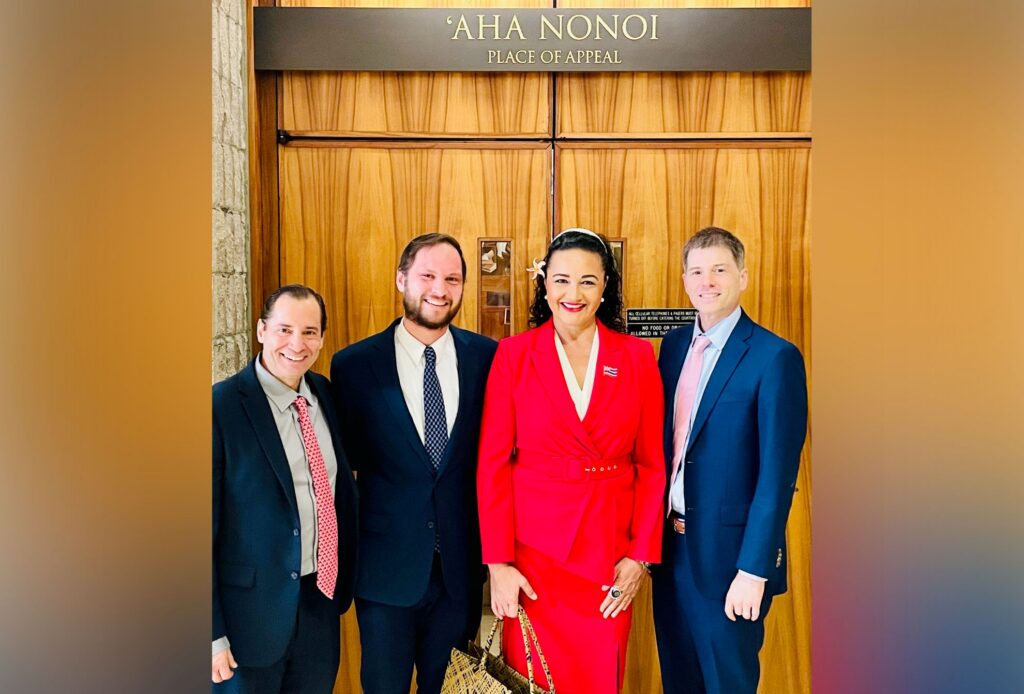
“This decision marks yet another victory for the First Amendment and for anyone who values the right to speak freely on political matters without government interference,” said The Babylon Bee CEO Seth Dillon. “We are grateful to Alliance Defending Freedom for representing us as we continue to challenge laws that treat comedy like a crime.”
“We the people have prevailed,” said ADF client Dawn O’Brien. “Eō, Hawai’i! I’m grateful for the court’s decision to block Governor Green and the Legislature’s law that would have stripped us of our constitutional freedoms. Mahalo ke Akua and mahalo to all who continue to fight for our freedoms in Hawai’i-nei.”
We must protect our freedom of speech, including the right to make satire about the government. After all, it is a hallmark of a free society to speak critically of those in authority. If we’ve lost that, we’ve lost an important piece of our democratic republic.
The Babylon Bee v. Lopez
- July 2024: Hawaii Governor Josh Green signed S2687 into law.
- June 2025: ADF attorneys representing The Babylon Bee and a Hawaii resident filed a lawsuit challenging the law in court.
- January 2026: A federal district court ruled that a Hawaii law that censors online political speech is unconstitutional.
Related Articles