In A Tale of Two Cities, Charles Dickens opens with a simple truth: the same crisis can draw out starkly different reactions from different communities.
That idea still resonates today—especially in the aftermath of Turning Point USA founder Charlie Kirk’s assassination.
Just ask Gabby Stout, a high school junior in North Carolina, and her family. They experienced starkly different reactions to Charlie’s murder.
And when Gabby tried to have her own somber, reflective response to Charlie’s death, her school arbitrarily changed the rules to blame her for vandalism—and worse.
Who is Gabby Stout?
Gabby Stout is a junior attending Ardrey Kell High School in North Carolina. For Gabby, the assassination of Charlie Kirk was horrifying, as she admired his boldness in advocating for and defending his Christian beliefs in the public square and his desire to engage those who disagreed with him in civil conversation.
In a desire to emulate Charlie Kirk’s boldness for his faith, Gabby wanted to remind her classmates, friends, and others in the Ardrey Kell High School community that Charlie Kirk had received and was enjoying eternal life with his Savior, Jesus Christ, and to create a space where students could memorialize him.
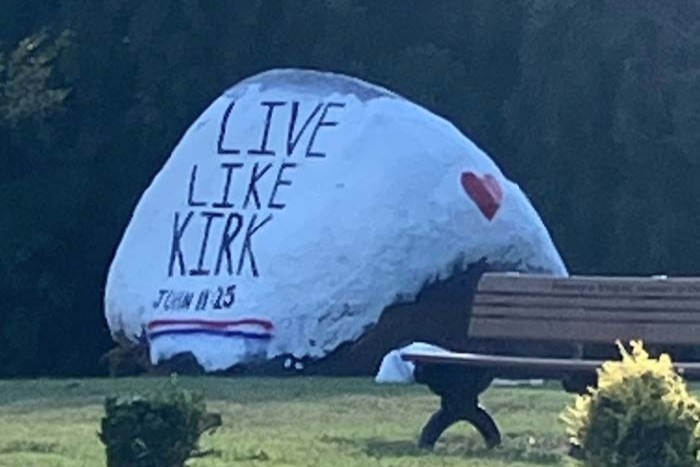
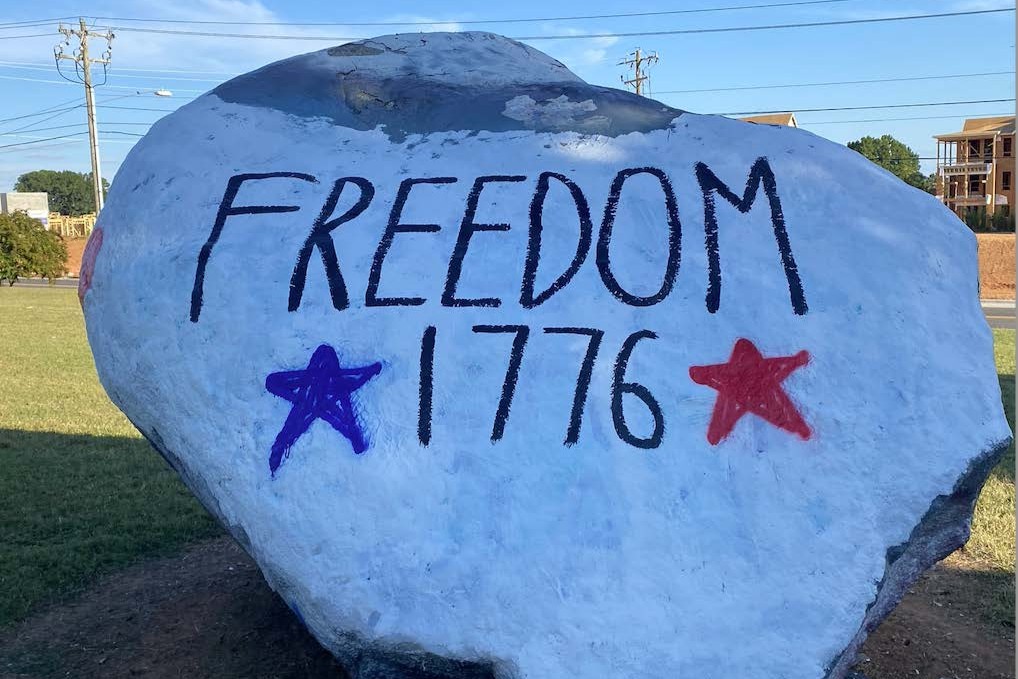
After receiving permission from school officials to paint the Ardrey Kell High School spirit rock with a patriotic message related to Charlie Kirk, that’s exactly what Gabby and two friends did. They painted the spirit rock with a heart, a United States flag, the message “Freedom 1776,” and a tribute to Charlie Kirk: “Live Like Kirk—John 11:25.”
Finally, they placed flowers in a vase at the base of the spirit rock.
As mentioned above, Gabby and her friends received all the proper permissions from the school to paint this memorial tribute.
So why did the school eventually call the police on her?
Ardrey Kell High School violates Gabby’s constitutional rights
Without explanation and despite granting permission, Ardrey Kell High School abruptly painted over Gabby’s tribute to Charlie Kirk within hours.
Concerningly, members of the Charlotte-Mecklenburg Board of Education had used the assassination of Charlie Kirk as an opportunity to air their grievances against him, often by taking his statements out of context and misrepresenting them.
One member took to social media to write: “[D]o not expect me to feel sorry, pitty [sic] or mournful for the man.”
That post showed that they did not respect Charlie, nor did they ever want to mourn for him. And those sorts of callous reactions set the tone for school district officials.
But it didn’t just end with the school censoring Gabby’s memorial.
The next day, school officials publicly accused her of a crime and a student conduct violation (vandalism). The school then told the families of all students that it had contacted law enforcement and was cooperating with a criminal investigation.
The day after that, school officials called Gabby out of class, forced her to write out a statement summarizing her rock-painting efforts, and forced her to edit that statement to include details they believed to be important. And they did this without first advising Gabby of her constitutional rights in any criminal proceeding, including the right to remain silent and the right to have legal counsel.
Somehow, it got even worse.
Later that same day, school officials again called Gabby out of class to interrogate her about the statement they forced her to write. Even more alarmingly, the school forced her to reveal data from her cell phone, without first obtaining consent from Gabby’s parents. The school still hadn’t advised Gabby of her constitutional rights in any criminal proceeding.
The next evening, the school unveiled its Revised Spirit Rock Speech Code. Under the revised code, students could no longer express “political” or “religious messages” on the spirit rock, including any “religious” and/or “political statements/symbols.”
Ardrey Kell High School and its officials gave themselves unbridled discretion to restrict student expression, as they require all student messages on the spirit rock to “reflect positive school spirit and uphold inclusive values,” to express “school-spirit and good news,” and to be in “good taste”—without defining these terms in any way.
Within three days, school officials knew that Gabby had not engaged in vandalism and quietly closed the criminal investigation against her. But they steadfastly refused to clear her name publicly, despite publicly accusing her of a crime before any investigation occurred. Instead, they issued false public statements, claiming they had never investigated her for anything.
Throughout all this, Gabby and her friends faced abuse from their peers and the public, all because of the school’s public claims of wrongdoing.
Schools have no business selectively punishing students for expressing their views
Simply put, students have the right to share their sincerely held beliefs without fear of wrongful censorship, retaliation, and punishment from schools. Plus, schools have an obligation to apply their rules fairly and consistently, without favoring some viewpoints over others.
While Ardrey Kell High School saw fit to censor and antagonize Gabby over the Charlie Kirk memorial, the school had no issue supporting student causes of a different ideological persuasion. For instance, when a BLM message on the spirit rock was painted over, the school acted swiftly to restore it. And school officials also helped facilitate and publicize a student protest against immigration enforcement actions where students walked out of class.
Gabby and her family fully recognize that not everyone shares their admiration for Charlie Kirk. However, they also recognize that Gabby has the constitutionally protected right to express her views in a forum that school officials created for student expression. And she should be able to express those views without officials censoring her or launching bogus criminal investigations against her because of her speech.
Schools certainly have no business dissuading Gabby and others from engaging in similar expression in the future, especially by imposing new viewpoint-based policies. But this school:
- Unconstitutionally censored Gabby’s speech that the First Amendment protects,
- Retaliated against her for exercising her First Amendment rights,
- Adopted new policies that violate her First Amendment rights,
- Violated the unconstitutional conditions doctrine,
- Ignored her Fourth and Fifth Amendment rights, and
- Deprived her of due process and equal protection of the laws.
High school should be a place where students learn to think, debate, and grow, not a place where their voices are censored, silenced, and policed. Students shouldn’t fear suspension or expulsion for what they believe. Free speech means everyone gets to speak without fear.
Because of these blatant violations, Alliance Defending Freedom attorneys are representing Gabby and her parents as they filed a lawsuit against the school district.
G.S. v. Charlotte-Mecklenburg Board of Education
- September 2025: Following the assassination of Charlie Kirk, Gabby received the proper permission to share her message on the Ardrey Kell High School spirit rock, before the school painted over it and helped launch a criminal investigation into her.
- December 2025: Represented by ADF attorneys, Gabby and her family filed a lawsuit against the Charlotte-Mecklenburg Board of Education.
Related Articles