Free speech is essential to a free society. That’s what our nation’s Founders understood, and it’s why they enshrined the God-given freedom of speech in the First Amendment.
Yet, many world leaders haven’t learned the lesson of our Founders. Instead, unelected officials in the European Union see free speech as a threat and censorship as a non-negotiable.
This has real-world effects on American citizens and American companies. Thanks to the EU’s censorship scheme known as the “Digital Services Act,” free speech is under threat as never before.
What is the EU’s Digital Services Act?
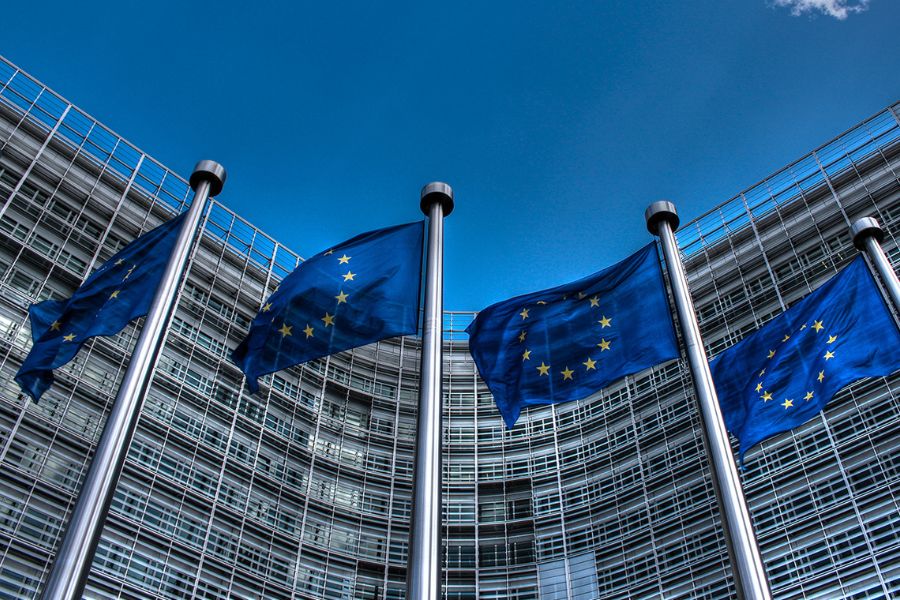
The European Union’s Digital Services Act (or DSA) is sold as a safety measure—a binding set of rules meant to curb “illegal content,” reduce online harm, and slow the spread of “disinformation.” That’s the official goal.
In practice, the DSA is an oppressive, all-encompassing digital censorship regime.
The law gives regulators sweeping discretion over what speech and content are considered acceptable. It pressures major players—Google, Meta, and X, for example—to conform to EU and EU Member State laws, even when they criminalize peaceful expression under broad and fluid censorship provisions.
At its core, the DSA hands the European Commission expansive authority over how the largest digital platforms operate and what kinds of content they are expected to police. The law was formally adopted in late 2022, with a lengthy transition period designed to give companies time to bring their systems into line.
By 2024, the new regime was fully in force, and the biggest platforms found themselves operating under a far more intrusive compliance structure than anything they had faced before in Europe—or abroad.
And the first major platform targeted by the DSA? Elon Musk’s social media platform, X.
The European Union’s $140 million muzzle on Elon Musk’s X
In December 2025, the European Commission slapped X with a $140 million fine.
The Commission accuses X’s “blue checkmark” verification system of being “deceptive.” Incredulously, the Commission makes the claim that X users struggle to understand the checkmark verification system that’s merely color-coded (i.e. a blue checkmark is one anyone can buy, a gray one is reserved for government officials or government organizations, and gold ones denote an official organization).
The Commission also called out the “lack of transparency” surrounding X’s ad repository and the lack of access researchers had to public data.
The Commission claimed that the $140 million fine “was calculated taking into account the nature of these infringements, their gravity in terms of affected EU users, and their duration.”
Musk and X could face further periodic penalties if they fail to present a so-called “solution” for these issues to the Commission.
Beyond the thin veneer, the EU Commission’s message is clear: Censor at our request or suffer the consequences.
Why did the European Commission really target X?
Lorcán Price, Legal Counsel with ADF International and an Irish barrister, recently spoke to the House Judiciary Committee about the encroaching threat of EU censorship. During that hearing, Lorcán was asked a simple question by Rep. Jim Jordan, the committee chairman.
“Mr. Price, why are they really going after X?” Rep. Jordan asked.
“Sir, it’s my view that they’re going after X because X has decided to take a maximalist position of free speech, to have the most possible free speech,” Lorcán answered. “And that’s inimical to their view, which is that we cannot have free speech.”
And that’s really the crux of it. The EU has decided that it knows best when it comes to free speech, which the governing body seems to characterize more like a nuisance than a right, despite clear EU law protecting free speech as a human right. And if any entity dares to oppose their calls for global censorship—like X—then they must be punished.
Worse yet, the EU isn’t content with warping the meaning of “free” speech within its own borders. It is attempting to use the DSA as a strong-arming mechanism to force the rest of the free world to bend to its views on free speech.
Americans need to understand what is at stake. The DSA was built for global speech control, and the speech it controls is ours—on the platforms we use every day. Today, it’s Elon Musk’s X in the crosshairs. Tomorrow, it could be any company—or any country—that refuses to be commandeered as the EU’s tool of narrative control. And that’s where this stops being a European problem and starts becoming an American one.
Why the DSA should concern Americans
We are long past the point where censorship is someone else’s problem—the DSA was built for global speech control, and Americans are not exempt. X is an American company, run by an American owner, used by millions of Americans. When the European Union pressures X to redesign systems, change policies, or redefine what speech is acceptable, those changes don’t stay neatly confined to Europe. They ripple outward, shaping what users everywhere can see, say, and share.
That’s not all. Because the DSA pressures big tech companies to carry out their censorship regime, the continent’s most restrictive laws now apply globally to every internet user—including those in the U.S. These laws have resulted in thousands of speech-related arrests and prosecutions throughout Europe, destroying the public square.
Vague concepts like “harmful content,” “systemic risk,” or “deceptive design” are endlessly elastic. Once regulators get comfortable using those categories to punish disfavored platforms, the line between consumer protection and viewpoint control becomes easier—and easier—to blur.
There’s also the chilling effect of this move. Regardless of how this turns out for Elon Musk’s X, other American companies may see this and capitulate to avoid even the potential of a nine-figure fine.
For Americans who still take the First Amendment seriously, that should set off alarms. The threat here isn’t that Brussels can repeal the Constitution. It’s that, little by little, foreign regulatory pressure can reshape the digital public square Americans rely on, without a single vote cast or law passed in Washington.
When an overseas bureaucracy can influence what speech survives on major U.S.-based platforms, the fight over X stops being about one company and starts being about whether “free speech” is going to be governed by American principles or by someone else’s.
The Digital Services Act was designed for global enforcement—and Americans are not exempt. Free speech doesn’t survive unless it’s defended. And that’s why Alliance Defending Freedom will defend free speech, regardless of whether the threat originates in Washington, D.C., your state capitol, or the EU Commission in Brussels.

Related Articles