

Key Takeaways
- More than half of the states, including West Virginia, have passed laws that protect women’s sports.
- This law was challenged, and the legal dispute would eventually reach the Supreme Court.
- Thankfully, the Supreme Court affirmed the rights of states to protect their female athletes.
Twenty-seven states, including West Virginia, have passed laws to ensure women and girls have a level playing field.
When it comes to secondary and collegiate athletics, West Virginia’s women’s sports law makes sure that males who identify as female cannot take a spot from a deserving girl on any girls’ athletic team.
The “Save Women’s Sports” law protects equal opportunity, fairness, and safety for women. But it was threatened by a lawsuit brought by the American Civil Liberties Union.
Alliance Defending Freedom intervened in the lawsuit on behalf of Lainey Armistead, a former collegiate athlete who played soccer at West Virginia State University (WSVU).
Who is Lainey Armistead?

For Lainey Armistead, soccer is far more than “just a game.” She defines it as a “passion and a life-defining pursuit.”
“Soccer was like the air I breathed growing up. I first kicked a soccer ball at three years old—almost as soon as I could walk,” Lainey says.
“I have made many sacrifices over the course of my athletic career to play the sport that I love. I have missed school dances, spring breaks, family events, and friends’ birthdays. I have given up my weekends and free time. I stay at school late for practice and get up early to train.”
“But I make these sacrifices because I want to be the best that I can be. I want to win—not just for myself, but also for my teammates.”
Lainey played left back for the Yellow Jackets and served as team captain.
Ensuring equal opportunities for women and girls
In 2021, West Virginia joined many other states in passing legislation that keeps males from competing in women’s sports. ADF helped draft the law, and West Virginia State Sen. Patricia Rucker sponsored the bill in the state legislature. Today, more than half of the states have laws on the books protecting women’s sports.
West Virginia’s commonsense law, often called the “Save Women’s Sports” law, ensures equal opportunities for women and girls in sports and protects their safety by making sure they are not forced to compete against males. But the American Civil Liberties Union challenged the law in federal court.
As a longtime athlete who could be directly affected by the law and the ACLU’s challenge to it, Lainey Armistead stood up to defend not only her own interests but also the basic standards of fairness and safety for female athletes across West Virginia.
Our laws must be grounded in biological reality
A male’s perception about his gender identity doesn’t erase his physical advantages over female athletes, and girls deserve to compete on a level playing field.
Soccer is a rough contact sport: concussions, knee injuries, and ankle injuries are common among female players. Add into the mix a male who races down the field at a faster pace, kicks the ball harder, and slams into other players with a larger physical frame, and the risk of injury to girls and women increases dramatically.
Allowing males to compete in girls’ sports destroys fair competition, safety on the field, and women’s athletic opportunities. When biological differences between men and women are ignored, people get hurt.
After Lainey intervened in the lawsuit, a federal district court ruled that West Virginia could enforce its law. But the U.S. Court of Appeals for the 4th Circuit reversed part of that decision and stripped West Virginia of its ability to protect fairness in women’s sports.
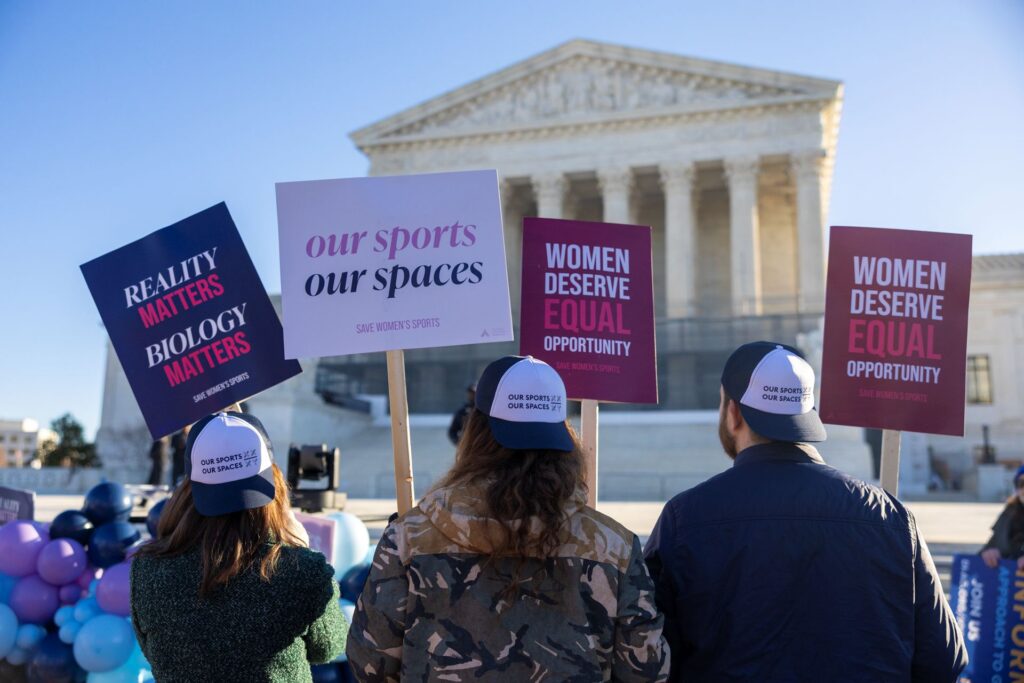
The state of West Virginia, state Attorney General JB McCuskey, and ADF attorneys representing Lainey (and serving as co-counsel for the state) appealed to the U.S. Supreme Court, and it agreed to hear the case. Oral arguments took place in January 2026.
Praise God, the Supreme Court ruled in favor of truth. In June 2026, the Supreme Court ruled 9-0 that Title IX empowers states like West Virginia to protect their female athletes. It also ruled 6-3 that the Equal Protection Clause of the 14th Amendment similarly allows states to protect the integrity of women’s sports.
Spearheaded by West Virginia Attorney General JB McCuskey and Idaho Attorney General Raúl Labrador, the Supreme Court ruling on their respective state laws is a massive win for girls, women, and truth across the country.
“This is a monumental victory for every female athlete who has ever competed, or dreamed of competing, on a fair and safe playing field,” McCuskey said.
“This decision is a victory for common sense, fairness, and the countless girls and women who dedicate themselves to athletics,” Labrador added.
The Supreme Court has now affirmed that states like West Virginia are free to enforce commonsense laws that ensure safety and fairness for female athletes. Now, it’s time for other states to follow suit.
State of West Virginia v. B.P.J.
- April 2021: West Virginia passed the “Save Women’s Sports” law.
- July 2021: A federal district judge temporarily blocked West Virginia from enforcing the law against the male plaintiff.
- September 2021: ADF attorneys representing Lainey Armistead filed a motion asking a federal district court to allow Lainey to intervene to defend the law.
- December 2021: The district court issued an order allowing Lainey to intervene.
- January 5, 2023: The federal district judge granted summary judgment in favor of Lainey and dissolved the preliminary injunction that was initially put in place, affirming that the women’s sports law is constitutional.
- February 2023: The plaintiff appealed that ruling to the U.S Court of Appeals for the 4th Circuit, which issued an injunction blocking West Virginia’s women’s sports law. The appeals court did not provide any rationale for its decision.
- March 2023: Attorneys with ADF and the West Virginia attorney general’s office filed a motion asking the Supreme Court to remove the appeals court’s injunction.
- April 2023: The Supreme Court declined to vacate the 4th Circuit’s injunction. The Court did not rule on the merits of the case.
- April 2024: The 4th Circuit reversed part of the lower court’s decision, stripping West Virginia of its ability to protect fairness in women’s sports.
- July 2024: The state of West Virginia, alongside ADF attorneys as co-counsel, asked the U.S. Supreme Court to hear the case.
- July 2025: The Supreme Court agreed to hear the case.
- January 2026: The Supreme Court heard oral arguments.
- June 2026: The Supreme Court ruled 9-0 that Title IX—a federal law that ensures equal opportunities for women in education—and 6-3 that the Equal Protection Clause of the 14th Amendment allows states to protect female athletes through sex-specific sports.
Related Articles