Key Takeaways:
- The First Amendment’s protection of pro-life speech is not a matter of opinion, and it has been affirmed by the Supreme Court.
- Pro-life speech deserves protection in every public square, every campus, every platform, and every journal.
- Free speech protects more than words. It also covers the freedom to associate, to publish, and to hire according to your convictions.
- Free speech is not divisible. A government that can silence pro-life voices can silence anyone’s.
Speaking the truth can, unfortunately, come with heavy consequences. And there’s no clearer example of that than what’s going on in America’s abortion debate.
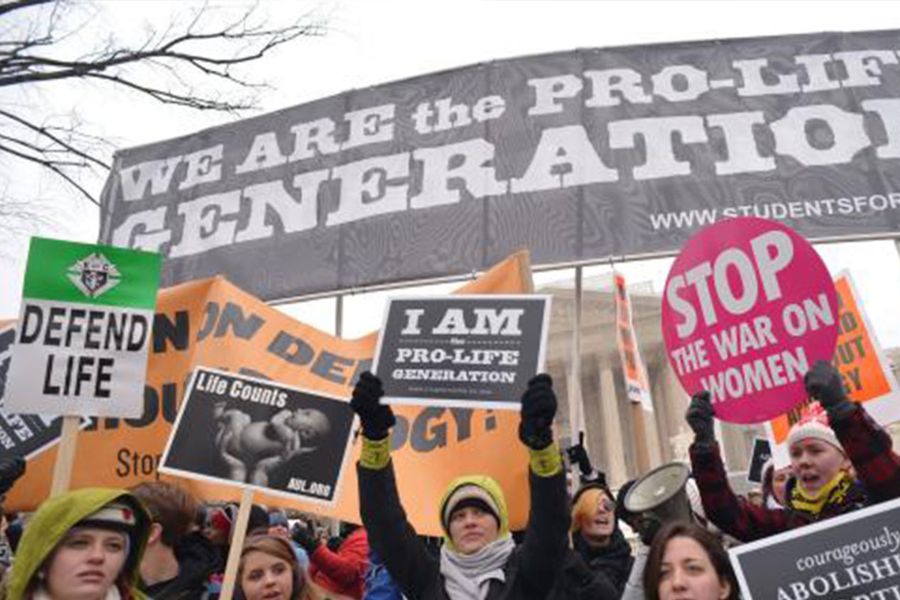
Despite what they bring to the conversation, pro-life voices are constantly being shouted down, deplatformed, silenced, escorted off campuses, prosecuted for standing on public sidewalks, and told that their speech was being treated as a threat.
These baseless allegations persist despite the fact that pro-life advocates are typically the ones bearing witness to the most concrete facts in the conversation—ultrasound images showing a heartbeat at six weeks, fetal development science, the testimony of women who regret their abortions and want other women to know what they weren’t told.
Importantly, pro-life advocates have verifiable evidence on their side
The irony would be almost funny if the consequences weren’t so serious.
The First Amendment was designed precisely to protect this sort of speech—and that includes speech that unsettles, that challenges, that refuses to stay quiet in the face of an uncomfortable truth. It was not designed to protect only the speech that powerful institutions happen to agree with. The First Amendment protects the right to speak—and that protection belongs to pro-life Americans as fully as it belongs to anyone else.
Protected on paper, silenced in practice
Pro-life speech is often the target of censorship. Whether on school campuses, outside abortion clinics, or in the public square, there are people in power who disagree with pro-life speech and seek to silence it.
But the First Amendment does not come with an ideological carve-out. It protects speech that is popular and speech that is not. It protects speech that powerful institutions agree with and speech that makes them uncomfortable. It protects speech about abortion and speech advocating for the sanctity of life.
This matters because the First Amendment is only as strong as the willingness to enforce it. A right that exists on paper but goes undefended in practice is not really a right at all. It becomes a courtesy, extended only until someone powerful enough decides to withdraw it.
That is dangerous. The consequences of leaving that injustice unchallenged extend far beyond the abortion debate. A government that can silence one category of disfavored speech can silence any speech. The principle at stake is not just whether pro-life Americans can speak freely—it’s whether the First Amendment means what it says.
Defending pro-life voices in every arena
The suppression of pro-life speech does not confine itself to one venue, and neither should the response to it.
Thankfully, the Supreme Court has increasingly recognized the protections that exist for pro-life speech, and several recent decisions stand as landmark victories for the First Amendment.
One of the first major decisions came in 2014. For years, Eleanor McCullen had witnessed women and men entering a Boston Planned Parenthood abortion facility. And for years, Eleanor had helped save countless lives from abortion by simply offering to have a conversation as a sidewalk counselor. But in 2007, Planned Parenthood successfully lobbied to have a “buffer zone” put around the Boston facility. For years, Eleanor had nowhere to stand but down the sidewalk or on a street opposite of the abortion facility, trying to call to women over the sound of traffic. Thankfully, in 2014, the Court unanimously declared that the law violated the First Amendment. It was not the last law that tried to curtail free speech rights, however.
The next major decision came in 2018, when the Court struck down a California law requiring pro-life pregnancy centers to advertise and refer for abortion services in NIFLA v. Becerra. The ruling established a principle as simple as it is significant: the government cannot force an organization to speak a message that contradicts its mission. Pro-life pregnancy centers exist to give women facing unexpected pregnancies support, resources, and life-affirming options—not to advertise alternatives that undermine everything they stand for.
The most recent major decision came in April 2026, when the Court ruled 9-0 in First Choice Women’s Resource Centers v. Davenport. New Jersey’s attorney general issued a sweeping subpoena—demanding up to a decade’s worth of sensitive information, including donor names and contact information, from a pro-life pregnancy center. First Choice provides parenting classes, free ultrasounds, and baby clothes to families across New Jersey. The ministry also makes it abundantly clear that it is a pro-life organization. That’s why it was so baffling that New Jersey issued this subpoena under the claim that First Choice was misleading potential donors about whether or not it performed abortions, despite not receiving any consumer complaints. Thankfully, the Supreme Court unanimously held the subpoena burdened First Choice’s First Amendment right to freely associate and entitled First Choice to hold the Attorney General accountable in federal court.
Pro-life science and medicine deserve a voice, too
Mackenna Greene is convinced her daughter is alive because a medical professional was allowed to speak. Less than a day after taking a chemical abortion drug, Mackenna was overwhelmed with regret. But with her mother’s help, she found Chelsea Mynyk, a licensed nurse practitioner in Colorado who began progesterone treatment, otherwise known as abortion pill reversal, immediately. After Chelsea’s intervention, praise God, in the summer of 2024, Mackenna gave birth to a healthy baby girl.
But Chelsea’s help wouldn’t have been possible if the state of Colorado had its way. Colorado passed a law banning abortion pill reversal and effectively prohibiting providers from even telling patients the option exists. In Bella Health and Wellness v. Weiser, ADF intervened on Chelsea’s behalf and won. A federal district court permanently blocked Colorado from enforcing the law against Bella Health and Chelsea, and Colorado officials agreed to pay $700,000 in attorneys’ fees to settle Chelsea’s part of the case in January 2026.
The suppression of pro-life speech has also extended into academia. In Studnicki v. Sage Publications, academic publisher Sage retracted three peer-reviewed articles by 10 nationally recognized scientists—two examining the dangers of chemical abortion drugs—without scientific justification. ADF is representing the researchers whose work was quietly erased, arguing that Sage’s viewpoint-discriminatory suppression of inconvenient research violated its publishing agreement.
The public square belongs to everyone
To understand what the First Amendment protects, it helps to see what happens without it. In the United Kingdom, so-called “buffer zones” have made peaceful, silent presence outside abortion facilities a criminal offense.
- U.K. Army veteran Adam Smith-Connor was convicted and ordered to pay prosecution costs of £9,000 for praying silently—with his back turned to the building, and not interacting with anyone—for his son, whom he had lost to abortion.
- Isabel Vaughan-Spruce has been arrested multiple times for silent prayer.
- Rose Docherty, a 75-year-old grandmother, was arrested twice for offering voluntary conversations — and had her charges dismissed in April 2026.
ADF International is supporting each of these cases because the principle that peaceful presence in a public space cannot be a crime is worth defending on both sides of the Atlantic.
In America, the First Amendment makes that defense considerably stronger. The Frederick Douglass Foundation and Students for Life of America were denied permission to paint a pro-life message on a Washington, D.C. street and sidewalk. They were denied despite other groups being free to write similar messages on streets and sidewalks in permanent paint throughout the city. Worse yet, police actually arrested two members for writing temporary messages in chalk in front of a D.C. Planned Parenthood. Because of all this, ADF filed suit. In Frederick Douglass Foundation v. District of Columbia, the D.C. Circuit Court reversed a lower court dismissal in 2023, allowing the case to proceed, and that case is now back before that Court. The government cannot open a public forum selectively, extending access to favored viewpoints while excluding others.
The public square, the First Amendment affirms, belongs to everyone.
Pro-life voices belong on campus, too
When Norvilia Etienne Cain arrived at Queens College in New York, she brought with her a conviction shaped by her own story: she had learned that her life had nearly been ended by abortion. And so, she wanted to start a pro-life student club. But the college refused to recognize it, cutting the group off from the funding, meeting spaces, and visibility extended to every other recognized organization on campus. After ADF filed a lawsuit, the college reversed course.
Norvilia’s experience is not unique. A Fresno State University professor ended up paying $28,000 and undergoing First Amendment training by ADF attorneys as part of a settlement after he instructed students from his class to join him in defacing and erasing a pro-life student group’s sidewalk chalk messages. In Fresno State Students for Life v. Thatcher, a federal court issued an order that prohibits the professor from interfering with that pro-life group’s message.
The First Amendment does not expire at the school entrance. Whether the setting is a high school hallway or a college campus, the principle is the same: pro-life voices belong in the conversation, and the First Amendment agrees.
The First Amendment protects who you hire, too
When people think of free expression, they typically think of what someone says: a sign on a sidewalk, a flyer on a campus bulletin board, a message painted on a street. But the First Amendment’s protection runs deeper than that. It also protects the freedom of association, which is the right of organizations to build teams around shared beliefs and common missions. For pro-life organizations, that freedom is just as important as any other form of protected speech.
If mission-driven organizations can’t decide whom they hire, they are forced to associate with individuals whose speech and conduct contradict the mission of that organization. In other words, a pro-life organization’s own employees could undermine its mission if they don’t align with the organization’s values.
In Illinois and Michigan, state governments have passed laws that test that principle directly. Illinois amended its employment law to require religious organizations to hire employees even if they act against their pro-life beliefs. Michigan went further, redefining unlawful discrimination to include the “termination of a pregnancy”—effectively requiring pro-life organizations to hire employees who could oppose their mission. ADF is challenging both laws in Pregnancy Care Center of Rockford v. Bennett and Right to Life of Michigan v. Nessel. The argument is straightforward: an organization’s ability to hire people who share and live out its convictions is not a privilege—it is a First Amendment right, and it deserves the same protection as every other form of free expression.
The First Amendment doesn’t pick favorites
The First Amendment was not written to protect popular speech. Popular speech generally doesn’t need protection; it takes care of itself. The First Amendment exists precisely for the speech that powerful institutions find inconvenient, uncomfortable, or threatening to their agendas. Pro-life speech qualifies on all three counts.
Free speech is not divisible. You cannot carve out one category of disfavored speech for special suppression and leave the rest of the First Amendment intact. The precedent set by silencing pro-life voices on a college campus is the same precedent that can be used to silence any voice on any campus. The subpoena served to a pro-life pregnancy center’s donor list is the same legal mechanism that could be turned on any nonprofit whose views fall out of favor.
The First Amendment is a gift given to us by our forefathers and was meant for all Americans. That absolutely includes pro-life voices.
Related Articles