

Key Takeaways:
- For the second consecutive year, a male athlete took home gold medals in two girls’ events at the track and field state championships in California.
- California’s “solution” wasn’t to change who could compete—it was to add extra spots on the podium, forcing the real winners to share first place.
- Women should never be forced to share their hard-earned accolades in women’s sports with a man.
From Margaret Abbott to Katie Ledecky, American history has been filled with exceptional female athletes winning gold medals at the highest levels of competition imaginable. Their stories are all unique.
Abbott didn’t even realize she was competing in the Olympics when she won first place in golf—fun fact: the 1900 Games predate the tradition of medals, and Abbott won a porcelain bowl instead. Ledecky’s decorated career has been celebrated across four Olympic Games and nine gold medals. Chloe Kim. Wilma Rudolph. Many others. Each of them earned their place on the podium through their own unique journeys of sacrifice, discipline, and competition against the best female athletes on earth.
But one thing they all have in common? They didn’t have to share a podium with a male athlete. No one suggested it. No governing body required it. Because the premise would have been laughed out of the room—a fundamental betrayal of everything women’s sports exist to celebrate and protect.
Unfortunately, what would have been unthinkable for any of them is the current official policy in California. And it is an absolute travesty for every girl who has ever put in hard work to dream of standing at the very top.
A picture is worth a thousand words
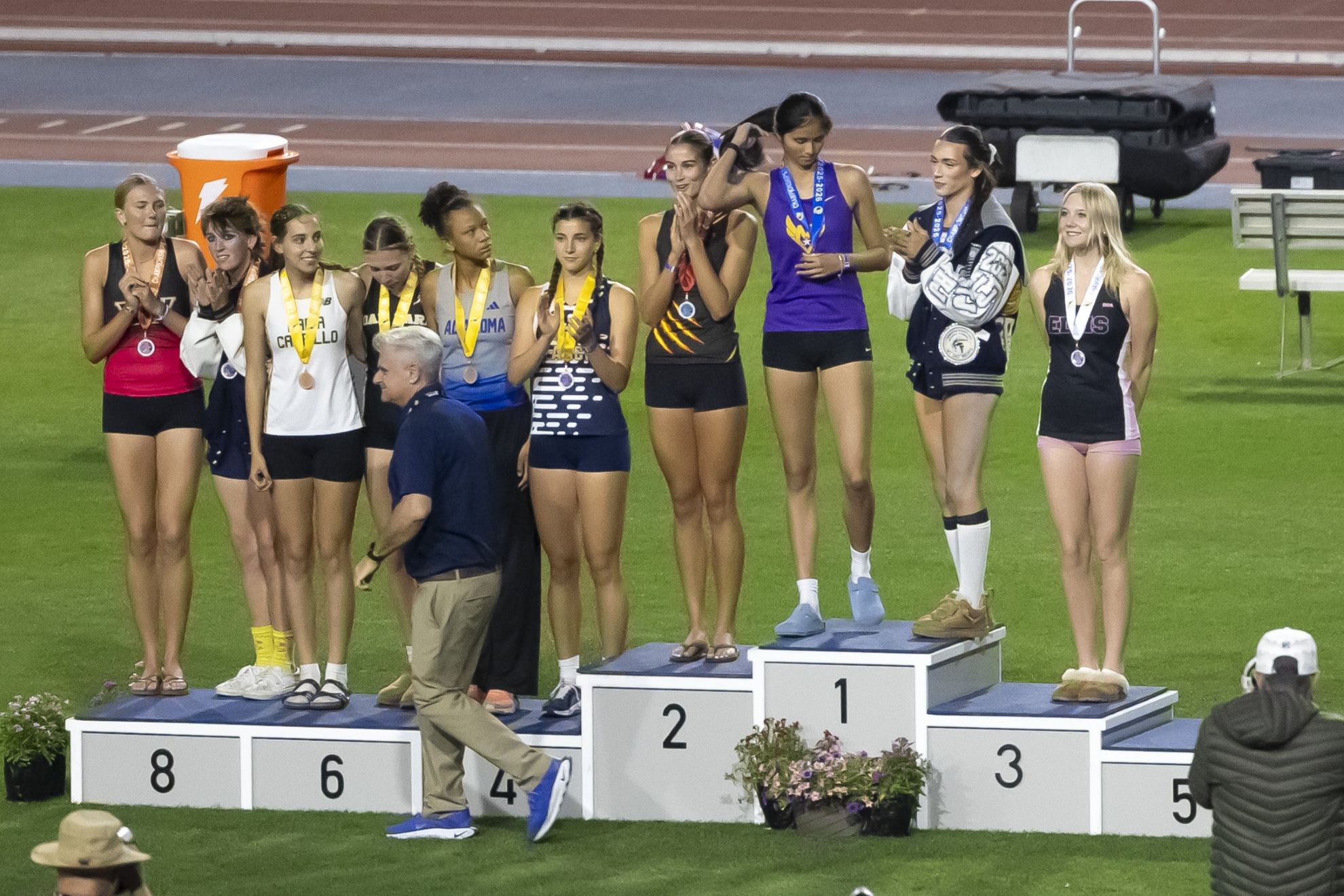
On May 30, the California Interscholastic Federation track and field state championships took place at Veterans Memorial Stadium in Clovis. Many events were contested, but two in particular—the girls high jump and triple jump—drew national attention.
Lelani Laruelle notched the best high jump among the girls, reaching 5-foot-8. Right behind her were two girls who reached 5-foot-7 and 5-foot-6. Meanwhile, Daniela Hughes had the best triple jump among the girls, reaching a distance of 41 feet and an inch. Second and third place got 40 feet, 10.5 inches, and 40 feet, respectively.
All six of these young women took their rightful place on the podium. They earned it. They trained for it. They showed up and competed against the best female high school athletes in the state of California and won.
But unlike those aforementioned Olympic scenes of women proudly hoisting gold medals (or in Abbott’s case, a porcelain bowl), this scene from California included an outsider.
AB Hernandez, a senior at Jurupa Valley High School in Riverside County, is the athlete in the above X post—and the outsider. Take a look at the faces of the competitors and onlookers in the background as Hernandez was just taking a practice jump. There’s something written there that goes beyond polite confusion. Call it disbelief. Call it the expression of people watching something happen in front of them that they know, instinctively, isn’t quite right.
Those reactions likely persisted into Hernandez’s performance.
The high school senior actually posted the best high jump mark of the day in the girls’ category, eclipsing Lelani’s jump by two inches. Hernandez also bested Daniela’s triple jump distance by over a foot and a half.
But Hernandez is also a male athlete standing on the podium, holding the same medal and occupying the same first-place position as the young women who actually belong there.
Let that sink in for a moment.
How was this allowed to happen?
California law requires the CIF to allow students to compete in accordance with their “gender identity.” The bill, enacted in August 2013, has been in effect since. That’s what effectively allowed Hernandez to compete in girls’ sports, and it’s a broader issue that ADF is fighting on multiple levels.
The peculiar podium policy, meanwhile, was announced by the CIF in May 2025 and was still in effect in 2026.
“[I]f necessary, in the high jump, triple jump and long jump events at the 2025 CIF State Track and Field Championships, a biological female student-athlete who would have earned a specific placement on the podium will also be awarded the medal for that place and the results will be reflected in the recording of the event,” the announcement stated.
(Of note, high jump, triple jump, and long jump were the three specific events that Hernandez competed in during the 2026 state championships.)
The podium policy was introduced alongside two other policy changes by the CIF. One change involved expanding the competition pool to include “biological female student-athletes” who had been displaced from qualifying for the state championships by offering them a spot to compete. The other change applied specifically to the same three events and opened up the competition pool there to allow any displaced female athletes in the preliminary rounds to advance to the state finals.
In other words, the CIF’s solution to a male athlete winning girls’ events was not to change who could compete. It was to add spots to the field and on the podium.
That is where things currently stand in the state of California.
The numbers tell a different story
The 2026 CIF state track and field championships didn’t just produce results. It produced evidence that California’s policy “solution” and the actual problem it was meant to address are miles—or, perhaps more accurately in this case, feet—apart.
Male athletes who wouldn’t even place in the male category still have enough biological advantages to win or displace female athletes in women’s sports. This was the case with AB Hernandez.
In the girls’ high jump, Hernandez won with a mark of 5 feet, 10 inches—good enough to claim first place in the girls’ division. But in the boys’ high jump, contested at the same championships, the last place finisher cleared 6 feet, 5 inches. The boys’ winner cleared 7 feet, 2 inches. Hernandez’s winning mark would not have placed in the boys’ final at all. Every single boy who made the state final cleared a height of at least seven inches higher. The boys’ winner cleared a full 16 inches higher. There is nothing subtle about that.
The triple jump tells the same story. Hernandez won the girls’ event with a distance of 42 feet, 8.75 inches. In the boys’ final, the last place finisher jumped 45 feet, 7.25 inches—nearly three feet further than Hernandez’s winning girls’ mark. The boys’ winner jumped 49 feet, 11.25 inches—more than seven feet further. Again, not even close.
Importantly, these are not hypothetical projections or statistical models. They are the official results from a single afternoon at the same championship meet, in the same events, recorded on the same day.
But even looking at different sports, in different events, on different days, the story remains remarkably consistent. Men have an athletic advantage—they are generally bigger, faster, and stronger than women. If the numbers bear this out to be true, why are men who wouldn’t even podium in their appropriate division being allowed to compete within women’s spaces?
This all illustrates precisely why male and female athletic competition has traditionally been separated—and why that separation exists to protect the integrity of female athletes and women’s sports.
Men can be incredible athletes. Women can be incredible athletes. That doesn’t mean they’re interchangeable. After all, men and women are created differently, and the data already bears this out.
And so does the scoreboard.
What happened at the CIF state championships was not an isolated incident. It was the predictable outcome of a policy framework that prioritizes ideology over biology and truth—and it is playing out in gymnasiums, swimming pools, and on tracks across the country. Lelani Laruelle and Daniela Hughes earned their spots on that podium. They deserved to stand there alone. No female should have to share a podium with a male.

Related Articles